
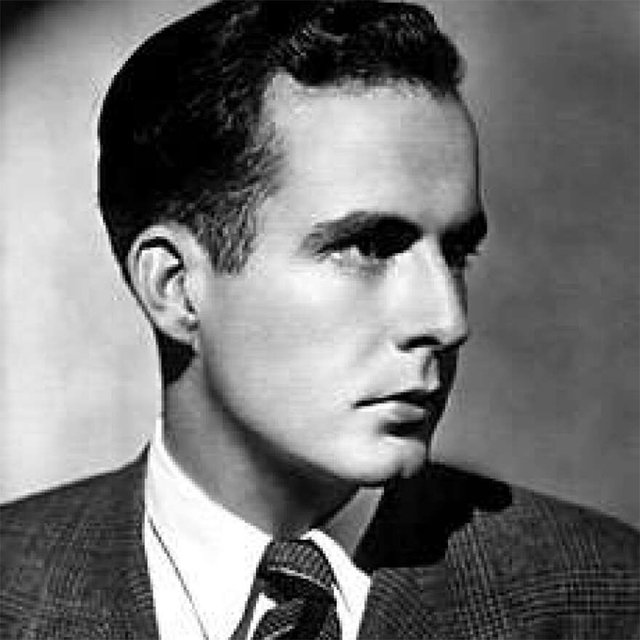
Samuel Barber
Composer
Samuel Osmond Barber II was born in West Chester, Pennsylvania on March 9, 1910. His father, Samuel Le Roy Barber (1879-1947), was a medical doctor and president of the West Chester school board for 25 years. His mother, Marguerite McLeod Beatty Barber (1881-1967), was a pianist. The eldest of two children, Barber dedicated many of his early works to his sister, Sara Fulton Barber. Barber’s maternal aunt, Louise Homer (1871-1947), was a leading contralto at New York’s Metropolitan Opera, and his uncle, Sidney Homer (1864-1953), was a composer of art songs, a type of vocal music composition typically written for one voice with piano accompaniment.
At a young age Barber had a belief that his career would be in music. At the age of 9, Barber began studying with William Hatton Green, a renowned piano teacher in West Chester who had studied under Theodor Leschetizky, one of the founders of the St. Petersburg Conservatory of Music in Russia. When Barber was 10, he wrote his first operetta, The Rose Tree, and at 12, he became an organist for West Chester’s Westminster Presbyterian Church. At 14, he entered the youth artist program at the Curtis Institute of Music in Philadelphia, where he developed his talents in composition, voice, and piano, while still attending public school in West Chester.
At West Chester High School, Barber was a noted scholar and participated in numerous extracurricular activities, including the Latin, French, music, and drama clubs, and was the editor of the literary yearbook. In 1928, Barber graduated from West Chester High School and immediately afterward entered the adult professional program at Curtis from which he graduated in 1934. During this period of study, Barber met fellow composition student, Gian Carlo Menotti, who would later become a personal and professional life partner. At the age of 18, Barber won the Joseph H. Bearns Prize from Columbia University for a violin sonata, and when he was 21, he won his second Bearns Prize for The School for Scandal, an orchestral work.
Early in his career Barber was a professional baritone, at one point holding a weekly singing contract with NBC radio; however, his forte remained with musical composition. In 1938, Arturo Toscanini directed Barber’s Adagio for Strings and Essay for Orchestra for the NBC Symphony Orchestra. In 1942, Barber joined the Army Air Corps and remained in service until 1945. In addition, he wrote several compositions for the Boston Symphony Orchestra, including his Second Symphony, which he had originally entitled Symphony Dedicated to the Air Force.
Following World War II, Barber wrote a ballet suite, Medea, for Martha Graham. In 1946, the U.S. State Department chose Barber to be a member of a delegation to the first Prague Spring International Music Festival where his music was performed with other American composers, including Leonard Bernstein. Also in 1946, Barber received a Guggenheim fellowship and studied privately with noted conductor George Szell. In 1949, Barber’s composition, Piano Sonata, which had been commissioned by Irving Berlin and Richard Rogers to mark the 25th anniversary of the League of Composers, achieved critical acclaim. During the 1950s, Barber conducted his own works with several symphony orchestras, including the Berlin Philharmonic, the Frankfurt Radio Symphony, and the Boston Symphony Orchestra. In 1958, Barber won his first Pulitzer Prize for his opera Vanessa, and in 1962, he won his second Pulitzer for his Piano Concerto, which had been commissioned for the opening of Lincoln Center. Also in 1962, Barber became the first American to go to the Congress of Soviet Composers, which convened in Moscow.
During the 1960s, Barber suffered issues with his health, and his opera Antony and Cleopatra (1966) did not win the critical praise to which he had become accustomed. Eventually Barber divided his time between his home in Mount Kisco, New York and his chalet in Santa Christina, Italy where he spent long periods in isolation. Even so, he was active in writing music until he was nearly 70 years of age.
Barber was hospitalized for the treatment of cancer off and on between 1978 and 1981. He died of the disease on January 23, 1981, in his Manhattan apartment. His funeral took place at the First Presbyterian Church, West Chester, and he was buried in the Barber family plot at Oaklands Cemetery, also in West Chester.
Source: Chester County History Center