Choral Masterworks
Program
Caroline Shaw: and the swallow
Felix Mendelssohn: Six Songs (Op. 59)
Im Grünen
Frühzeitiger Frühling
Abschied vom Walde
Die Nachtigall
Ruhetal
Jagdlied
Ēriks Ešenvalds: In Paradisum
Anton Bruckner: Os justi
Zoltán Kodály: The Aged
Zoltán Kodály: See the Gypsies
Arvo Pärt: Which Was the Son of . . .
Featuring
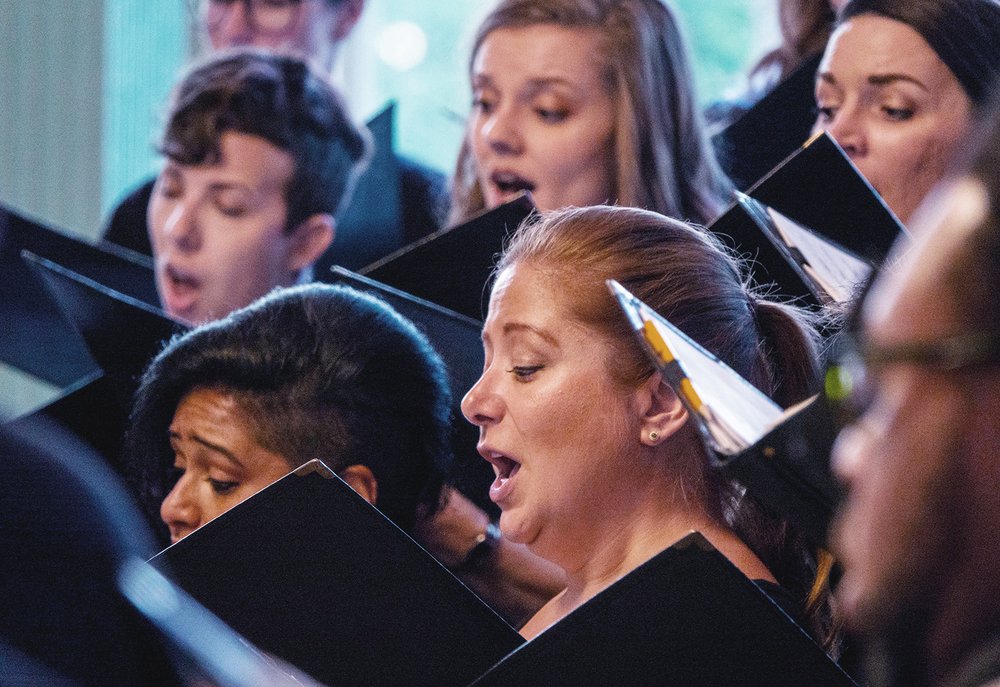
Grant Park Chorus
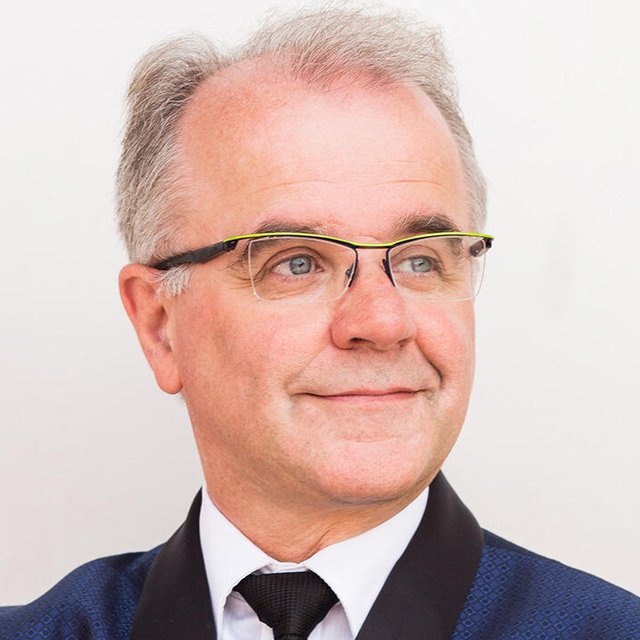
Carlos Kalmar, conductor
Christopher Bell, chorus director
Program Notes
Caroline Shaw wrote and the swallow in 2017 in response to the Syrian refugee crisis. Taking its text from Psalm 84, the piece conveys “a yearning for home that feels very relevant today,” Shaw said. Just as the swallow in the psalm is looking for a nest where she may lay her young, so too are families looking for a place where they can keep their family safe. Starting in low homophony, the sopranos soar wordlessly upward, mimicking the bird’s flight. Soon, the rest of the choir joins in with overlapping ascending hums. Shaw, known for her fondness for extended vocal techniques, then evokes the sound of the autumn rain with a bed of soft repeated “n’s” under the final phrase.
Although Felix Mendelssohn is best known for his instrumental music and large-scale choral works like Elijah, the composer wrote a surprising number of intimate unaccompanied choral pieces called part-songs. While he only released four volumes of part-songs during his lifetime, another three sets were published posthumously, and others remain in manuscript form. Mendelssohn intended for many of these part-songs to be sung outside and even subtitled this set of Six Songs, op. 59 “Im Freien zu singen,” or “to be sung outdoors.” In a letter to his mother dated July 3, 1839, Mendelssohn recounted the joy of singing with a small amateur chorus in the forest outside of Frankfurt: “How lovely the song sounded, how clearly the sopranos trilled in the air, and what a glow and charm enveloped all the pitches, everything so quiet and furtive and yet so clear—that I couldn’t have imagined . . . it was magical in the forest solitude, so that tears almost came to my eyes. It sounded like pure poetry.”
Mendelssohn composed Six Songs, op. 59 between 1837 and 1843. Mirroring their intended performance venue, many of the songs feature texts on the Romantic themes of nature and springtime. Most are simple strophic settings, where the same musical material is used for multiple verses. Only occasionally does Mendelssohn employ imitative counterpoint for contrast, as in “Die Nachtigall.” Otherwise, the homophonic textures maximize the accessibility of the songs and the comprehensibility of the text. Given its artful simplicity, the elegiac “Abschied im Walde” gained particular popularity and even folksong status.
Before turning his professional sights to composition, Latvian composer Ēriks Ešenvalds studied at the Latvian Baptist Theological Seminary for two years. Still deeply religious, Ešenvalds often turns to religious subjects for his works. In paradisum, an antiphon from the Latin Requiem Mass, is traditionally sung when the body is taken from the church for burial at the end of the funeral service. Dedicated to his grandmother Irma, who passed away the morning of the work’s premiere in 2012, the piece evokes the gentle beating of angels’ wings as they guide the soul to its eternal rest in paradise. In the beginning, the chorus is barely audible, humming and singing wordlessly under the solo cello’s elegy, before opening up into a slow-moving, chant-like statement of the text. The chorus recedes into the background again, reappearing with increasingly impassioned declamations before dissipating again like a fading heartbeat.
Although Anton Bruckner is most often remembered for his monumental symphonies, sacred music dominated much of the composer’s career. It served as a direct expression of his deeply held Catholic faith instilled in him as a child singing at St. Florian’s monastery near Linz, Austria. Much of Bruckner’s sacred music reflects the ethos of the Cecilian reform movement that dominated Catholic church music in the late 1800s. The aim of the movement was to restore the dignity and purity of church music, which its proponents believed had become corrupted by the “worldliness” of post-Enlightenment secular music. Dedicated to the music director at St. Florian’s, Os justi meditabitur is a prime example of Bruckner’s adherence to this philosophy. Written in 1879, the motet is informed by Gregorian chant and the 16th-century polyphony of Palestrina. It is also set in the Lydian church mode and strictly avoids the use of any sharps or flats, lending it an ancient feel.
One year before his death, Hungarian composer Zoltán Kodály wrote, “Our age of mechanization leads along a road ending with man himself as a machine; only the spirit of singing can save us from this fate.” Vocal music was important to Kodály throughout his life and formed the foundation of not only his compositional output but also his scholarly work and the pedagogical method that bears his name. In the early 20th century, Kodály and his friend Béla Bartók went on tours of rural Hungary, recording thousands of folksongs on phonograph cylinders in an effort to preserve and codify their musical heritage. Of the nearly 150 unaccompanied songs Kodály wrote, many are arrangements of these folksongs or have folk-inflected rhythms or melodies. Composed in 1933, Öregek (“The Aged”) is set to a poem by Sándor Weöres. The plodding, descending motion in the lower voices captures the slow movement and perhaps resignation of a person in later life. In contrast, Túrót eszik a cigány (“See the Gypsies Munching Cheese”) is an arrangement of a playful Romani dancing song. As a result of its accessibility and lightheartedness, the song is a popular choice among children’s choirs.
Estonian composer Arvo Pärt is best known for his minimalist, serialist compositional style inflected by traditional melodic and harmonic elements of Renaissance, Medieval, and Eastern Orthodox sacred music. It perhaps comes as no surprise, then, that he would choose to set a highly repetitive portion of Luke’s Gospel in Which was the son of... The context of the commission drew Pärt to this text that painstakingly outlines Jesus’ genealogy. In 2000, Pärt was asked to compose a work for the youth choir Voices of Europe, which was gathering in Reykjavik to celebrate the city’s status as the European Capital of Culture that year. Knowing Iceland’s passion for genealogy and tradition of passing on names from one generation to another, Pärt turned to this rarely set passage of Luke’s Gospel and its string of ancient names.
In lesser composers’ hands, this text might become like a recitation of the phone book. Instead, Pärt avoids monotony by employing a variety of musical characters and textures. The piece opens assuredly, calling to mind Spirituals in its use of call and response between the upper and lower voices. A more flowing section in 9/8 follows, building to a climax with the recitation of the names Jacob, Isaac, and Abraham in a gleaming C major. Finally, Pärt leads us through the circle of fifths to a simple resolution on “which was the son of God”—the whole crux of the passage.
Event Sponsors
This program is generously supported as part of the Dehmlow Choral Music Series.
Artistic Leadership

Support The Festival


Grant Park Orchestra
* denotes leave-of-absence † one-year position
Jeremy Black, concertmaster
Jennifer Cappelli
Injoo Choi
Dima Dimitrova
Erica Hudson
Hyewon Kim
Matthew Lehmann
Jayna Park
Rika Seko
Karen Sinclair
Bonnie Terry
Trista Wong
Jonathan Yi
Krzysztof Zimowski
Liba Shacht, principal
Laura Miller, assistant principal
Ying Chai
Ran Cheng
Karl Davies
Likai He
Tiffany Kang
Ann Lehmann
Cristina Muresan
Kjersti Nostbakken
Irene Radetzky
Jeanine Wynton
Thomas Yang
Terri Van Valkinburgh, principal
Yoshihiko Nakano, assistant principal
Patrick Brennan*
Elizabeth Breslin
Beatrice Chen
Amy Hess
Christopher McKay†
Rebecca Swan
Chloé Thominet
Walter Haman, principal
Peter Szczepanek, assistant principal
Calum Cook
Larry Glazier
Steven Houser
Eric Kutz
Eran Meir
Linc Smelser*
Colin Corner, principal
Peter Hatch, assistant principal
Andrew Anderson
Alexander Horton
Christian Luevano†
Isaac Polinksy†
Timothy Shaffer*
Chunyang Wang
Chris White
Mary Stolper, principal
Jennifer Debiec Lawson, assistant principal
Jennifer Debiec Lawson
Alyce Johnson
Mitchell Kuhn, principal
Alex Liedtke
Anne Bach, assistant principal
Anne Bach
Dario Brignoli, principal
Trevor O’Riordan
Eric Hall, principal
Nicole Haywood, assistant principal
William Ramos
Jonathan Boen, principal
Stephanie Blaha, assistant principal*
Fritz Foss†
Samuel Hamzem†
Brett Hodge*
Neil Kimel
David Gordon, principal
Mike Brozick, acting assistant principal
Michael Brozick
William Denton
Daniel Cloutier, principal*
Jeremy Moeller, acting principal
Alexander Mullins
Andrew Smith, principal
Daniel Karas, principal
Josh Jones, principal
Joel Cohen, assistant principal
Doug Waddell
Kayo Ishimaru-Fleisher, principal
Christopher Guzman
Alba Layana Izurieta, Violin
Janani Sivakumar, Violin
Harper Randolph, Viola
Gabriel Hightower, Cello
Grant Park Chorus
* denotes leave-of-absence † one-year position
Taylor Adams
Summer Aebker
Kristina Bachrach
Madalynn Baez
Megan E. Bell
Alyssa Bennett
Anna Joy Buegel
Laura Bumgardner
Elisabeth Burmeister
Katherine Buzard
Bethany Clearfield
Nathalie Colas
Corinne Costell
Carolyne DalMonte
Rebecca Fitzpatrick
Megan Fletcher
Kaitlin Foley
Saira Frank
Katherine Gray-Noon
Kimberly Gunderson
Alexandra Ioan
Alexandra Kassouf
Darlene Kelsey
Olivia Knutsen
Marybeth Kurnat
Catherine Larson
Katelyn Lee
Rosalind Lee
Rena Maduro
Hannah Dixon McConnell
Marie McManama
Meganna Miller
Kathleen Monson
Emily Mwila
Susan Nelson
Evangeline Ng
Karen R. Nussbaum
Máire O’Brien
Laura Perkett
Molly Phelan
Angela Presutti Korbitz
Alexia Rivera
Veronica Samiec
Whitney Shurtliff
Emily Sinclair
Tiana Sorenson
Christine Steyer
Diana Stoic
Karlie Traversa
Sarah van der Ploeg
Lydia Walsh-Rock
Sherry Watkins
Tara Wheeker
Emily Lyday Yiannias
Christina Adams
Melissa Arning
Christina Bernardoni
Christine Boddicker
Bethany Brewer
Jean Broekhuizen
Anna De Ocampo Kain
Julie DeBoer
Leah Dexter
Katrina Dubbs
Stacy Eckert
Margaret Fox
Elizabeth Frey
Liana German
Catarine Hancock
Ruth Ginelle Heald
Nina Heebink
Miya Higashiyama
Carla Janzen
Amy Allyssa Johnson
Kathryn Kinjo Duncan
Amanda Koopman
Jeannette Lee
Hannah Little
Thereza Lituma
Chelsea Lyons
Victoria Marshall
Jessica McCarthy
Greta McNamee
Quinn Middleman
Sarah Ponder
Emily Price
Lauren Randolph
Grace Ryan
Stephanie Schoenhofer
Suzanne A. Shields
Emlynn Shoemaker
Cassidy Smith
Emma Sorenson
Aidan Spencer
Alannah Spencer
Carolyn Sundlof Boudreau
Gabrielle Timofeev López
Corinne Wallace-Crane
A.J. Wester
Debra Wilder
Pamela Williams
Avery Winick
Enrico Giuseppe Bellomo
Justin Berkowitz
Madison Bolt
Eric Botto
Hoss Brock
Steven Caldicott Wilson
Joseph Cloonan
Damon Cole
John J. Concepción
Matthew Cummings
Micah A. Dingler
Howard Eckdahl
Jared V. Esguerra
Andrew Fisher
Ryan Frenk
Ace Gangoso
Klaus Georg
Nikhil Harle
Jianghai Ho
Max Hosmer
Cameo T. Humes
Paul Hunter
Garrett Johannsen
William Johnson
James Judd
Tejas Kishan Gururaja
Tim Lambert
Tyler Lee
Mason Montuoro
Stephen D. Noon
Brett Potts
Nicholas Pulikowski
Brian Rasmussen
Patrick Reardon
Peder Reiff
Matthew W. Schlesinger
Silfredo Serrano
Joe Shadday
Aaron Short
Matthew Sink
Brian Skoog
Michael St. Peter
Ryan Townsend Strand
Brett Sweeney
Alan Taylor
Keven Washburn
Sean J. Watland
Walter Aldrich
Evan Bravos
Matthew Brennan
Tabes Bridges
Michael Cavalieri
Stephen Clark
David Corlew
Michael D. Costello
Philip Courington
Ryan J. Cox
Ed Frazier Davis
Wesley Diener
Chris DiMarco
Christopher Filipowicz
Gabriel Garcia
Dimitri German
Dominic German
David Govertsen
David Hartley
Matthew Hunt
Brian Hupp
Jan Jarvis
Jess Koehn
Zachary Mendenhall
Eric Miranda
Ron Mitchell
Ian Morris
Ian Murrell
Chiemerie Obianom
John E. Orduña
Wilbur Pauley
Douglas Peters
Jackson Pierzina
Anthony Pilcher
Martin Lowen Poock
Ian Prichard
Gabriel Reitemeier
Dan Richardson
Stephen Richardson
Benjamin D. Rivera
Joseph Ryan
Ivo Suarez
Avery Sujkowski
Scott Uddenberg
Vince Wallace
Nicholas Ward
Aaron Wardell
Ronald Watkins
Jonathon Weller
Peter Wesoloski
Max Wier
Jonathan Wilson
Chuck Foster
John Goodwin
Veronica Mak, soprano
Emily Amesquita, alto
Alexi Ortega Chavez, tenor
Lifan Deng, bass