Dvořák Serenade for Strings
Program
Jesse Montgomery Starburst
Béla Bartók Romanian Folk Dances
Stick Dance
Waistband Dance
Stamping Dance, or On the Spot
Hornpipe Dance
Romanian Polka
Quick Dance
Heitor Villa-Lobos Bachiana Brasileiras No. 9
Ária (Cantilena)
Michael Abels Delights and Dances
Augusta Read Thomas Of Paradise and Light
Edvard Grieg Last Spring
Antonin Dvorak Serenade for Strings
Moderato
Tempo di valse
Scherzo: Vivace
Larghetto
Finale: Allegro vivace
Featuring
Grant Park Festival String Fellow Alumni
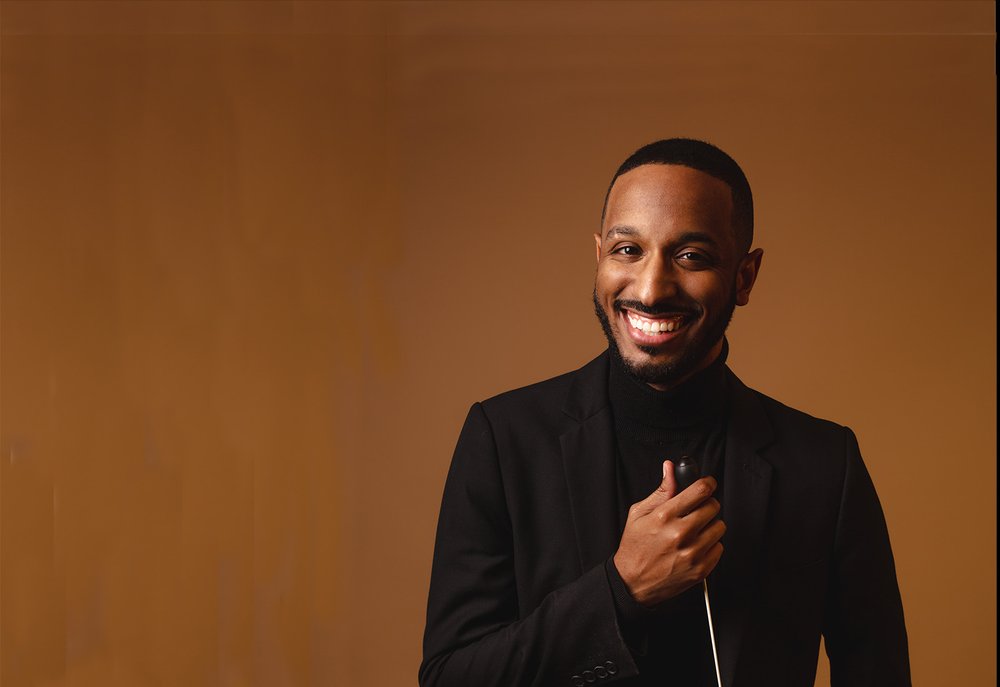
Kyle Dickson, conductor
Shaina Martinez, soprano
Imara Miles, mezzo-soprano
Program Notes
Jessie Montgomery: Starburst
In the field of astronomy, a starburst is the sudden formation of vast quantities of stars. The rate and volume of creation is so high that it alters the structure of the entire galaxy. Composer Jessie Montgomery (b. 1981) evokes this flurry of energy in Starburst, a short one-movement work for string orchestra. She creates a multidimensional soundscape by mixing explosive, syncopated phrases with fleet-footed runs and undulations to capture what she calls the “imagery of rapidly shifting colors.” Starburst was commissioned in 2012 by The Sphinx Organization, a Detroit-based nonprofit dedicated to increasing the representation of Black and Latinx artists in classical music. The organization’s groundbreaking chamber orchestra, The Sphinx Virtuosi, inspired the imagery of the piece and gave the work’s premiere.
When Hungarian composer Béla Bartók (1881–1945) was in his twenties, he became absorbed by the folk music of his homeland. With the help of his friend and fellow composer Zoltán Kodály, he traveled throughout Hungary and neighboring countries collecting and systematically cataloguing thousands of folk songs. From that point on, all of Bartók’s compositional output became influenced by this native music, either quoting folk melodies directly or incorporating characteristic elements such as modes and irregular rhythms.
Romanian Folk Dances, originally composed for piano in 1915 and orchestrated by the composer two years later, is a set of six brief vignettes based on Transylvanian folk tunes that would have been played on the fiddle or shepherd’s pipe. Although brief, the six dances all differ greatly in affect. First, we hear the pompous stomping of “Stick Dance,” followed by the flirtatious “Sash Dance.” “In One Spot” then evokes a Middle Eastern flute played over a drone. The slow “Dance from Bucsum,” also called “Horn Dance,” gives us a moment of respite before the vigorous dances of the final two movements.
Brazilian composer Heitor Villa-Lobos (1887–1959) once said, “The map of Brazil was my harmony textbook.” Largely self-taught, Villa-Lobos absorbed the diverse cultural heritage of his homeland and blended it with European modernism. Around the same time that Béla Bartók was traveling Eastern Europe collecting folk music, Villa-Lobos was undertaking his own ethnomusicological excursions in northeastern Brazil. “I study the history, the country, the speech, the customs, the background of the people,” he said. “I have always done this. It is from these sources, spiritual as well as practical, that I have drawn my art.”
Composed between 1930 and 1945, Bachianas Brasileiras is a suite of nine pieces that pay tribute to one of Villa-Lobos’ favorite composers, Johann Sebastian Bach. Though there are no direct quotations of Bach’s music in Bachianas Brasileiras, Villa-Lobos presents German baroque techniques and forms through the lens of Brazilian folk idioms. The last in the set, No. 9, takes the shape of a baroque prelude and fugue. In the slow, mystical prelude, the theme of the subsequent fugue is introduced in long note values over a pedal tone. Lush harmonies swirl and build anticipation for the fugue to come. In the fugue, the cellos induce the subject in the jaunty time signature of 11/8. In true baroque fashion, Villa-Lobos continues to develop the theme and places it in dialogue with a secondary motive in the violins before reintroducing the fugue subject in full, gradually adding layer upon layer before ending in a resounding unison.
Delights and Dances by Michael Abels (b. 1962) is another commission courtesy of the Sphinx Organization. Written in 2007 to commemorate the organization’s tenth anniversary, Delights and Dances is scored for a solo string quartet and string orchestra. When Abels was studying at the University of California, he explored his African-American roots by studying gospel music and African drumming alongside the traditional classical curriculum. As a result, his music often presents elements of blues, jazz, gospel, and bluegrass within classical frameworks. Delights and Dances is no different. Abels calls the piece “a kind of diptych of American musical genres, one regarded as ‘black’ and the other ‘white.’”
The slow introduction begins with a rhythmically free cadenza in the solo cello. The solo viola then answers the cello’s questioning ascending motif, and the two play a rapturous duet. After the two solo violins enter, the tension mounts, eventually giving way to a bluesy section. Here, the soloists take turns playing improvisatory-sounding riffs over the orchestra’s syncopated pizzicato accompaniment. Though in a decidedly bluesy hue, this section remains upbeat. The subsequent bluegrassy section recalls a boisterous hoedown. Again, the soloists show off their virtuosity with increasingly dazzling declamations.
A composer integral to the contemporary music scene in Chicago, Augusta Read Thomas (b. 1964) is a professor of composition at the University of Chicago and founder/director of the Chicago Center for Contemporary Composition. Of Paradise and Light (2010) is a string transcription of a work Read Thomas composed for girls’ chorus in 2008, which sets the poem “Kiss Me” by e e cummings. Similar in mood and conception to Barber’s Adagio for Strings, Of Paradise and Light is meditative work that Read Thomas says evokes “a sliver of paradise and light [that] came down to shine upon a garden of colorful flowers.”
Norwegian composer Edvard Grieg wrote many songs based on poems by fellow countryman Asmund Olavsson Vinje. Vinje, in addition to writing poetry, worked as a journalist and travel writer. His treks through the Norwegian countryside helped to engender a spirit of nationalism. In his poem “Last Spring,” a dying man relishes the sweetness of springtime.
Antonín Dvořák was in a happy period of his life when he wrote Serenade for Strings in 1875. Dvořák’s career was starting to take off, and he was gaining increased recognition outside of his Czech homeland. Earlier that year, he had won a grant for needy artists from a commission in Vienna, of which Johannes Brahms was a part. This stipend allowed Dvořák to compose without fear of leaving him and his young family impoverished. Consequently, 1875 was a prolific year for Dvořák, resulting in his Fifth Symphony, the first volume of Moravian Dances, several chamber works, and the Serenade for Strings. Dvořák wrote the Serenade at a blistering pace, completing it in just twelve days. However, it would not see public performance for over a year. Though a violist from the Vienna Philharmonic attempted to add the Serenade to the orchestra’s repertoire, the ensemble deemed Dvořák too obscure. However, the successful Prague premiere in December 1876 and subsequent performances in Czech cities continued to boost the composer’s visibility at home and abroad.
The happiness and stability of this time in his life shine through in this sunny work. Despite its accessibility, Serenade for Strings demonstrates Dvořák’s increasing sophistication and refinement as a composer with its use of modulations and dynamic shifts within a concise package. Apart from the finale, the movements are loosely cast in A-B-A song form, adding to the work’s approachability. Dvořák’s melodic gift is on immediate display in the opening Moderato, with a blithe cantabile theme presented over pulsing violas. The following Tempo di Valse features a swirling minor-key waltz, whereas the Scherzo is lively and frenetic, interspersed with more lyrical trio sections. The Larghetto acts as a wistful buffer between the vigorous Scherzo and the Finale, which evokes a rustic Bohemian village dance. Dvořák brings the work full circle by quoting the opening theme of the Moderato before closing with a presto coda.
Program notes by Katherine Buzard
Event Sponsors
This concert is made possible by the Paul M. Angell Family Foundation, and generous gifts from Nancy Dehmlow and an Anonymous Donor.
The Festival’s Fellowships are graciously supported by Peter and Lucy Ascoli, Dr. Scholl Foundation, Colleen and Lloyd Fry and the Lloyd A. Fry Foundation, Barbara Dana Klein, Nancy Meyerson (In Memory of Al Lewis), and the Sandra and Earl J. Rusnak, Jr. Cello Fellowship Fund.
Artistic Leadership

Support The Festival
Grant Park Orchestra
* denotes leave-of-absence † one-year position
Jeremy Black, concertmaster
Jennifer Cappelli
Injoo Choi
Dima Dimitrova
Erica Hudson
Hyewon Kim
Matthew Lehmann
Jayna Park
Rika Seko
Karen Sinclair
Bonnie Terry
Trista Wong
Jonathan Yi
Krzysztof Zimowski
Liba Shacht, principal
Laura Miller, assistant principal
Ying Chai
Ran Cheng
Karl Davies
Likai He
Tiffany Kang
Ann Lehmann
Cristina Muresan
Kjersti Nostbakken
Irene Radetzky
Jeanine Wynton
Thomas Yang
Terri Van Valkinburgh, principal
Yoshihiko Nakano, assistant principal
Patrick Brennan*
Elizabeth Breslin
Beatrice Chen
Amy Hess
Christopher McKay†
Rebecca Swan
Chloé Thominet
Walter Haman, principal
Peter Szczepanek, assistant principal
Calum Cook
Larry Glazier
Steven Houser
Eric Kutz
Eran Meir
Linc Smelser*
Colin Corner, principal
Peter Hatch, assistant principal
Andrew Anderson
Alexander Horton
Christian Luevano†
Isaac Polinksy†
Timothy Shaffer*
Chunyang Wang
Chris White
Mary Stolper, principal
Jennifer Debiec Lawson, assistant principal
Jennifer Debiec Lawson
Alyce Johnson
Mitchell Kuhn, principal
Alex Liedtke
Anne Bach, assistant principal
Anne Bach
Dario Brignoli, principal
Trevor O’Riordan
Eric Hall, principal
Nicole Haywood, assistant principal
William Ramos
Jonathan Boen, principal
Stephanie Blaha, assistant principal*
Fritz Foss†
Samuel Hamzem†
Brett Hodge*
Neil Kimel
David Gordon, principal
Mike Brozick, acting assistant principal
Michael Brozick
William Denton
Daniel Cloutier, principal*
Jeremy Moeller, acting principal
Alexander Mullins
Andrew Smith, principal
Daniel Karas, principal
Josh Jones, principal
Joel Cohen, assistant principal
Doug Waddell
Kayo Ishimaru-Fleisher, principal
Christopher Guzman
Alba Layana Izurieta, Violin
Janani Sivakumar, Violin
Harper Randolph, Viola
Gabriel Hightower, Cello
Grant Park Chorus
* denotes leave-of-absence † one-year position
Taylor Adams
Summer Aebker
Kristina Bachrach
Madalynn Baez
Megan E. Bell
Alyssa Bennett
Anna Joy Buegel
Laura Bumgardner
Elisabeth Burmeister
Katherine Buzard
Bethany Clearfield
Nathalie Colas
Corinne Costell
Carolyne DalMonte
Rebecca Fitzpatrick
Megan Fletcher
Kaitlin Foley
Saira Frank
Katherine Gray-Noon
Kimberly Gunderson
Alexandra Ioan
Alexandra Kassouf
Darlene Kelsey
Olivia Knutsen
Marybeth Kurnat
Catherine Larson
Katelyn Lee
Rosalind Lee
Rena Maduro
Hannah Dixon McConnell
Marie McManama
Meganna Miller
Kathleen Monson
Emily Mwila
Susan Nelson
Evangeline Ng
Karen R. Nussbaum
Máire O’Brien
Laura Perkett
Molly Phelan
Angela Presutti Korbitz
Alexia Rivera
Veronica Samiec
Whitney Shurtliff
Emily Sinclair
Tiana Sorenson
Christine Steyer
Diana Stoic
Karlie Traversa
Sarah van der Ploeg
Lydia Walsh-Rock
Sherry Watkins
Tara Wheeker
Emily Lyday Yiannias
Christina Adams
Melissa Arning
Christina Bernardoni
Christine Boddicker
Bethany Brewer
Jean Broekhuizen
Anna De Ocampo Kain
Julie DeBoer
Leah Dexter
Katrina Dubbs
Stacy Eckert
Margaret Fox
Elizabeth Frey
Liana German
Catarine Hancock
Ruth Ginelle Heald
Nina Heebink
Miya Higashiyama
Carla Janzen
Amy Allyssa Johnson
Kathryn Kinjo Duncan
Amanda Koopman
Jeannette Lee
Hannah Little
Thereza Lituma
Chelsea Lyons
Victoria Marshall
Jessica McCarthy
Greta McNamee
Quinn Middleman
Sarah Ponder
Emily Price
Lauren Randolph
Grace Ryan
Stephanie Schoenhofer
Suzanne A. Shields
Emlynn Shoemaker
Cassidy Smith
Emma Sorenson
Aidan Spencer
Alannah Spencer
Carolyn Sundlof Boudreau
Gabrielle Timofeev López
Corinne Wallace-Crane
A.J. Wester
Debra Wilder
Pamela Williams
Avery Winick
Enrico Giuseppe Bellomo
Justin Berkowitz
Madison Bolt
Eric Botto
Hoss Brock
Steven Caldicott Wilson
Joseph Cloonan
Damon Cole
John J. Concepción
Matthew Cummings
Micah A. Dingler
Howard Eckdahl
Jared V. Esguerra
Andrew Fisher
Ryan Frenk
Ace Gangoso
Klaus Georg
Nikhil Harle
Jianghai Ho
Max Hosmer
Cameo T. Humes
Paul Hunter
Garrett Johannsen
William Johnson
James Judd
Tejas Kishan Gururaja
Tim Lambert
Tyler Lee
Mason Montuoro
Stephen D. Noon
Brett Potts
Nicholas Pulikowski
Brian Rasmussen
Patrick Reardon
Peder Reiff
Matthew W. Schlesinger
Silfredo Serrano
Joe Shadday
Aaron Short
Matthew Sink
Brian Skoog
Michael St. Peter
Ryan Townsend Strand
Brett Sweeney
Alan Taylor
Keven Washburn
Sean J. Watland
Walter Aldrich
Evan Bravos
Matthew Brennan
Tabes Bridges
Michael Cavalieri
Stephen Clark
David Corlew
Michael D. Costello
Philip Courington
Ryan J. Cox
Ed Frazier Davis
Wesley Diener
Chris DiMarco
Christopher Filipowicz
Gabriel Garcia
Dimitri German
Dominic German
David Govertsen
David Hartley
Matthew Hunt
Brian Hupp
Jan Jarvis
Jess Koehn
Zachary Mendenhall
Eric Miranda
Ron Mitchell
Ian Morris
Ian Murrell
Chiemerie Obianom
John E. Orduña
Wilbur Pauley
Douglas Peters
Jackson Pierzina
Anthony Pilcher
Martin Lowen Poock
Ian Prichard
Gabriel Reitemeier
Dan Richardson
Stephen Richardson
Benjamin D. Rivera
Joseph Ryan
Ivo Suarez
Avery Sujkowski
Scott Uddenberg
Vince Wallace
Nicholas Ward
Aaron Wardell
Ronald Watkins
Jonathon Weller
Peter Wesoloski
Max Wier
Jonathan Wilson
Chuck Foster
John Goodwin
Veronica Mak, soprano
Emily Amesquita, alto
Alexi Ortega Chavez, tenor
Lifan Deng, bass