Fascinating Rhythm: Gershwin and Friends
Program
GEORGE GERSHWIN
Strike Up The Band
Fascinating Rhythm
But Not for Me
They Can’t Take That Away From Me
I Got Rhythm
Love Is Here To Stay
S’Wonderful
The Man I Love
Lady Be Good
IRVING BERLIN
Alexander’s Ragtime Band
Blue Skies
Always
JEROME KERN
Look for the Silver Lining
VINCENT YOUMANS
I Want To Be Happy
ISHAM JONES
It Had To Be You
Featuring
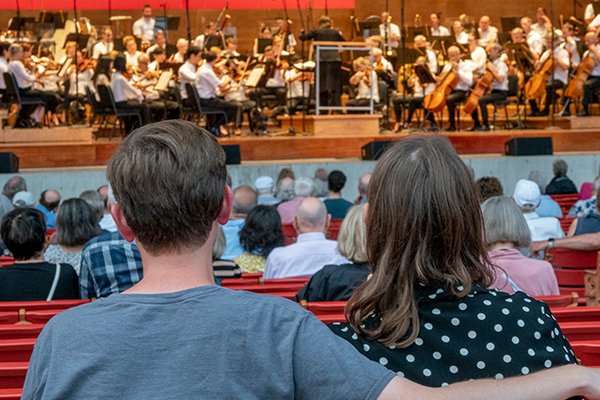
Grant Park Orchestra
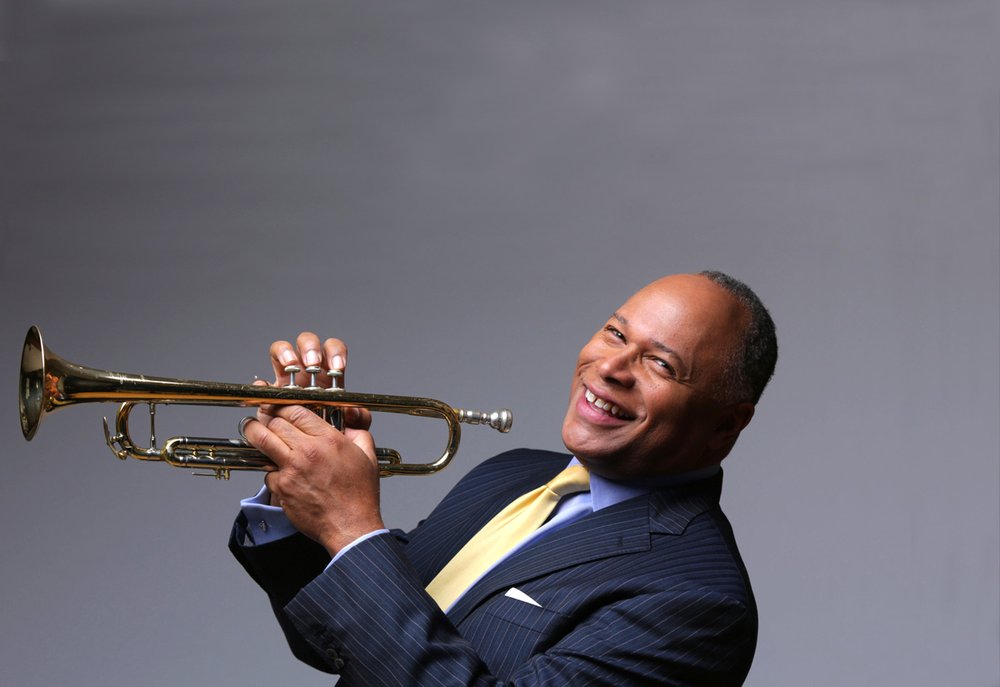
Byron Stripling, conductor, trumpet, vocals
Bobby Floyd, piano
Sydney McSweeney, vocals
Jim Rupp, drums
Program Notes
Lyricist Oscar Hammerstein II once said, “A song’s not a song ’til you sing it.” In tonight’s concert, you will hear some of the most beloved songs of the early 20th century, which make up what is known as “The Great American Songbook.” The Great American Songbook is not an actual book or collection of specific songs. Instead, it is a term for the canon of show tunes, jazz standards, and popular songs that have stood the test of time through reinterpretation by countless artists. Unlike classical music, where the notes and rhythms on the page are not generally subject to change from performer to performer, these songs have no “definitive” version but live on through their mutability. As each artist puts their own stamp on these century-old songs, they gain new life. They stand up so well today, not just because they are great tunes, but because they speak to universal human experiences of love and loss and reflect our hopes and dreams.
The Great American Songbook grew out of Tin Pan Alley, Broadway, and Hollywood. Tin Pan Alley refers to a specific street in New York City that was home to the major publishers of popular music between the 1880s and 1920s. It was so called because the cacophony of songwriters and pluggers banging out tunes on cheap upright pianos sounded like the clattering of tin pans. Before the advent of radio and recording technology, the popular music industry’s main source of income was sheet music sales. Publishers hired composers to write the songs as well as song pluggers to entice people to buy the sheet music or convince performers to insert them into their shows. Irving Berlin, Jerome Kern, George Gershwin, and Vincent Youmans all cut their teeth as song pluggers on Tin Pan Alley before trying their hand at composing, as it offered an entry into the music industry and a fertile training ground.
It was on Tin Pan Alley that numerous musical influences coalesced to create the sound of American musical theatre. Minstrel shows, vaudeville, and operetta dominated popular music at the turn of the 20th century. Finding a distinctly “American” voice apart from the influence of European operetta became imperative after World War I, as audiences no longer wished to see the misadventures of dukes and princesses play out on stage. When the Great Migration brought African Americans to northern cities, white songwriters were introduced to forms of Black musical expression like ragtime, the blues, and jazz. While none of these composers can claim to have written authentic jazz or ragtime, elements of these homegrown musical idioms soon made their way into the music of Broadway, helping to give it a language and identity apart from European influence. In turn, jazz musicians borrowed songs from Broadway, turning them into jazz standards long after they had disappeared from the stage.
Irving Berlin’s “Alexander’s Ragtime Band” (1911) is an early example of this melding of styles. While the song is more of a march than ragtime, it borrowed the syncopated energy from ragtime and repackaged it for a white audience. The song ushered in a new sound and catapulted Berlin’s career. Born Israel Beilin, Irving Berlin (1888–1989) immigrated to the United States with his family in 1893, fleeing the anti-Jewish pogroms in Russia. Like many other Eastern European Jewish immigrants, they lived in a squalid apartment on the Lower East Side. Berlin left home at 13, singing for money on the street before getting a job as a singing waiter at a saloon. Although he had no formal training and could not read music, he eventually got a job as a staff lyricist and composer for the publisher/songwriter Ted Snyder in 1909. (One of his many musical secretaries who helped him notate his songs was the 20-year-old George Gershwin.) Throughout his career, Berlin churned out hit song after hit song, including “Always” (1925), written as a wedding present for his wife, and “Blue Skies” (1926) to commemorate the birth of their first child. Berlin’s story epitomized the rags-to-riches American Dream as he reinvented himself and popular music in the American image.
Another influential figure in the development of the American sound was Jerome Kern (1885–1945). While also the son of Jewish immigrants (though of German origin), Kern grew up relatively affluent and had more formal compositional training than Berlin. Early in his career as a song plugger on Tin Pan Alley, he wrote songs for interpolation into European operettas. During World War I, he left operetta behind, focusing on more realistic, contemporary, and American situations and characters. He changed the trajectory of the Broadway musical by emphasizing a unity of lyrics and music, bearing fruit in his masterwork, Show Boat (1927). “Look For The Silver Lining” (Sally, 1920) exemplifies his more lyrical, Old-World style that contrasted with the ebullient Jazz-Age musicals to come.
Kern was George Gershwin’s greatest influence, particularly early in his career. “I followed Kern’s works and studied each song he composed,” Gershwin wrote. “I paid him the tribute of frank imitation, and many things I wrote at this period sounded as though Kern had composed them himself.” Like Berlin, Gershwin (1898–1937) was born to Russian Jewish immigrant parents and Americanized his name (from Jacob Gershovitz). He also left school before graduating, becoming the youngest song plugger on Tin Pan Alley at age 15, where he worked for Jerome H. Remick. He later signed with Kern’s publishing house, T. B. Harms, making his name with standalone songs and music for revues.
Rhapsody in Blue (1924) marked a turning point in Gershwin’s career and musical style, leading him to inflect his musical scores with the spirit of jazz that had won him praise in Rhapsody. Gershwin soon dominated theatres with a series of musical comedy romps that captured the energy of the Roaring Twenties with their dance rhythms, jazzy harmonies, and vernacular language. Lady, Be Good! (1924), for instance, gives us “Fascinating Rhythm” and “Oh, Lady Be Good” as well as “The Man I Love,” which, though it was cut from the musical, achieved status as a standard nonetheless. Part of the musical’s success was Gershwin’s burgeoning collaboration with his brother, lyricist Ira Gershwin, and dancer Fred Astaire. Another Gershwin–Astaire hit was Funny Face (1927), which gives us “’S Wonderful.”
The Gershwin brothers’ creative partnership only deepened over time. After the commercial failure of the political satire Strike Up The Band (1927/30), Girl Crazy (1930) was the Gershwins’ strongest score yet, bolstered by the singing of Broadway newcomer Ethel Merman in “I Got Rhythm” and Ginger Rogers in “But Not For Me”. When the Great Depression decimated funding for new Broadway productions, Hollywood came knocking. In Los Angeles, the Gershwins reunited with Astaire for the film Shall We Dance (1937; “They Can’t Take That Away From Me”). Gershwin’s last complete song was “Love Is Here To Stay,” which appeared posthumously in the film The Goldwyn Follies (1938).
Ira Gershwin collaborated with other composers both before and after his brother’s death. One such composer was Vincent Youmans (1898–1946) for his early musical Two Little Girls In Blue (1921). Born one day after George Gershwin, Youmans also started out by plugging songs for Jerome H. Remick. His biggest hit was the musical No, No, Nanette (1925), which gives us “Tea for Two” and “I Want To Be Happy.” The only composer on the program who did not make his start on Tin Pan Alley is Isham Jones (1894–1956). The bandleader, saxophonist, bassist, and songwriter began his career in Chicago, leading one of the most popular dance bands and making a series of hit gramophone recordings. “It Had To Be You,” with lyrics by Gus Kahn, topped the charts in 1924.
Program Notes by Katherine Buzard
Event Sponsors
This program is graciously supported as part of the Hanson Community Connections Series. Sponsorship support is generously provided by American Accents Series Sponsor AbelsonTaylor Group. Media sponsorship is provided by WDCB.
Artistic Leadership
-

Christopher Bell
Chorus Director

Support The Festival


Grant Park Orchestra
* denotes leave-of-absence † one-year position
Jeremy Black, concertmaster
Jennifer Cappelli
Injoo Choi
Dima Dimitrova
Erica Hudson
Hyewon Kim
Matthew Lehmann
Jayna Park
Rika Seko
Karen Sinclair
Bonnie Terry
Trista Wong
Jonathan Yi
Krzysztof Zimowski
Liba Shacht, principal
Laura Miller, assistant principal
Ying Chai
Ran Cheng
Karl Davies
Likai He
Tiffany Kang
Ann Lehmann
Cristina Muresan
Kjersti Nostbakken
Irene Radetzky
Jeanine Wynton
Thomas Yang
Terri Van Valkinburgh, principal
Yoshihiko Nakano, assistant principal
Patrick Brennan*
Elizabeth Breslin
Beatrice Chen
Amy Hess
Christopher McKay†
Rebecca Swan
Chloé Thominet
Walter Haman, principal
Peter Szczepanek, assistant principal
Calum Cook
Larry Glazier
Steven Houser
Eric Kutz
Eran Meir
Linc Smelser*
Colin Corner, principal
Peter Hatch, assistant principal
Andrew Anderson
Alexander Horton
Christian Luevano†
Isaac Polinksy†
Timothy Shaffer*
Chunyang Wang
Chris White
Mary Stolper, principal
Jennifer Debiec Lawson, assistant principal
Jennifer Debiec Lawson
Alyce Johnson
Mitchell Kuhn, principal
Alex Liedtke
Anne Bach, assistant principal
Anne Bach
Dario Brignoli, principal
Trevor O’Riordan
Eric Hall, principal
Nicole Haywood, assistant principal
William Ramos
Jonathan Boen, principal
Stephanie Blaha, assistant principal*
Fritz Foss†
Samuel Hamzem†
Brett Hodge*
Neil Kimel
David Gordon, principal
Mike Brozick, acting assistant principal
Michael Brozick
William Denton
Daniel Cloutier, principal*
Jeremy Moeller, acting principal
Alexander Mullins
Andrew Smith, principal
Daniel Karas, principal
Josh Jones, principal
Joel Cohen, assistant principal
Doug Waddell
Kayo Ishimaru-Fleisher, principal
Christopher Guzman
Alba Layana Izurieta, Violin
Janani Sivakumar, Violin
Harper Randolph, Viola
Gabriel Hightower, Cello
Grant Park Chorus
* denotes leave-of-absence † one-year position
Taylor Adams
Summer Aebker
Kristina Bachrach
Madalynn Baez
Megan E. Bell
Alyssa Bennett
Anna Joy Buegel
Laura Bumgardner
Elisabeth Burmeister
Katherine Buzard
Bethany Clearfield
Nathalie Colas
Corinne Costell
Carolyne DalMonte
Rebecca Fitzpatrick
Megan Fletcher
Kaitlin Foley
Saira Frank
Katherine Gray-Noon
Kimberly Gunderson
Alexandra Ioan
Alexandra Kassouf
Darlene Kelsey
Olivia Knutsen
Marybeth Kurnat
Catherine Larson
Katelyn Lee
Rosalind Lee
Rena Maduro
Hannah Dixon McConnell
Marie McManama
Meganna Miller
Kathleen Monson
Emily Mwila
Susan Nelson
Evangeline Ng
Karen R. Nussbaum
Máire O’Brien
Laura Perkett
Molly Phelan
Angela Presutti Korbitz
Alexia Rivera
Veronica Samiec
Whitney Shurtliff
Emily Sinclair
Tiana Sorenson
Christine Steyer
Diana Stoic
Karlie Traversa
Sarah van der Ploeg
Lydia Walsh-Rock
Sherry Watkins
Tara Wheeker
Emily Lyday Yiannias
Christina Adams
Melissa Arning
Christina Bernardoni
Christine Boddicker
Bethany Brewer
Jean Broekhuizen
Anna De Ocampo Kain
Julie DeBoer
Leah Dexter
Katrina Dubbs
Stacy Eckert
Margaret Fox
Elizabeth Frey
Liana German
Catarine Hancock
Ruth Ginelle Heald
Nina Heebink
Miya Higashiyama
Carla Janzen
Amy Allyssa Johnson
Kathryn Kinjo Duncan
Amanda Koopman
Jeannette Lee
Hannah Little
Thereza Lituma
Chelsea Lyons
Victoria Marshall
Jessica McCarthy
Greta McNamee
Quinn Middleman
Sarah Ponder
Emily Price
Lauren Randolph
Grace Ryan
Stephanie Schoenhofer
Suzanne A. Shields
Emlynn Shoemaker
Cassidy Smith
Emma Sorenson
Aidan Spencer
Alannah Spencer
Carolyn Sundlof Boudreau
Gabrielle Timofeev López
Corinne Wallace-Crane
A.J. Wester
Debra Wilder
Pamela Williams
Avery Winick
Enrico Giuseppe Bellomo
Justin Berkowitz
Madison Bolt
Eric Botto
Hoss Brock
Steven Caldicott Wilson
Joseph Cloonan
Damon Cole
John J. Concepción
Matthew Cummings
Micah A. Dingler
Howard Eckdahl
Jared V. Esguerra
Andrew Fisher
Ryan Frenk
Ace Gangoso
Klaus Georg
Nikhil Harle
Jianghai Ho
Max Hosmer
Cameo T. Humes
Paul Hunter
Garrett Johannsen
William Johnson
James Judd
Tejas Kishan Gururaja
Tim Lambert
Tyler Lee
Mason Montuoro
Stephen D. Noon
Brett Potts
Nicholas Pulikowski
Brian Rasmussen
Patrick Reardon
Peder Reiff
Matthew W. Schlesinger
Silfredo Serrano
Joe Shadday
Aaron Short
Matthew Sink
Brian Skoog
Michael St. Peter
Ryan Townsend Strand
Brett Sweeney
Alan Taylor
Keven Washburn
Sean J. Watland
Walter Aldrich
Evan Bravos
Matthew Brennan
Tabes Bridges
Michael Cavalieri
Stephen Clark
David Corlew
Michael D. Costello
Philip Courington
Ryan J. Cox
Ed Frazier Davis
Wesley Diener
Chris DiMarco
Christopher Filipowicz
Gabriel Garcia
Dimitri German
Dominic German
David Govertsen
David Hartley
Matthew Hunt
Brian Hupp
Jan Jarvis
Jess Koehn
Zachary Mendenhall
Eric Miranda
Ron Mitchell
Ian Morris
Ian Murrell
Chiemerie Obianom
John E. Orduña
Wilbur Pauley
Douglas Peters
Jackson Pierzina
Anthony Pilcher
Martin Lowen Poock
Ian Prichard
Gabriel Reitemeier
Dan Richardson
Stephen Richardson
Benjamin D. Rivera
Joseph Ryan
Ivo Suarez
Avery Sujkowski
Scott Uddenberg
Vince Wallace
Nicholas Ward
Aaron Wardell
Ronald Watkins
Jonathon Weller
Peter Wesoloski
Max Wier
Jonathan Wilson
Chuck Foster
John Goodwin
Veronica Mak, soprano
Emily Amesquita, alto
Alexi Ortega Chavez, tenor
Lifan Deng, bass