Scheherazade
Program
LILI BOULANGER D’un matin de printemps (Of a Spring Morning)
FRANCIS POULENC Stabat Mater
Stabat Mater dolorosa
Cujus animam gementem
O quam tristis
Quae moerebat
Quis est homo
Vidit suum
Eja Mater
Fac et Ardeat
Sancta Mater
Fac ut portem
Inflammatus et accensus
Quando corpus
INTERMISSION
NIKOLAI RIMSKY-KORSAKOV Scheherazade
The Sea and Sinbad’s Ship
The Tale of Prince Kalendar
The Young Prince and the Princess
The Festival at Baghdad; The Sea; The Ship Goes to Pieces on a Rock
Featuring
Grant Park Orchestra
Grant Park Chorus
Eric Jacobsen, conductor
Christopher Bell, chorus director
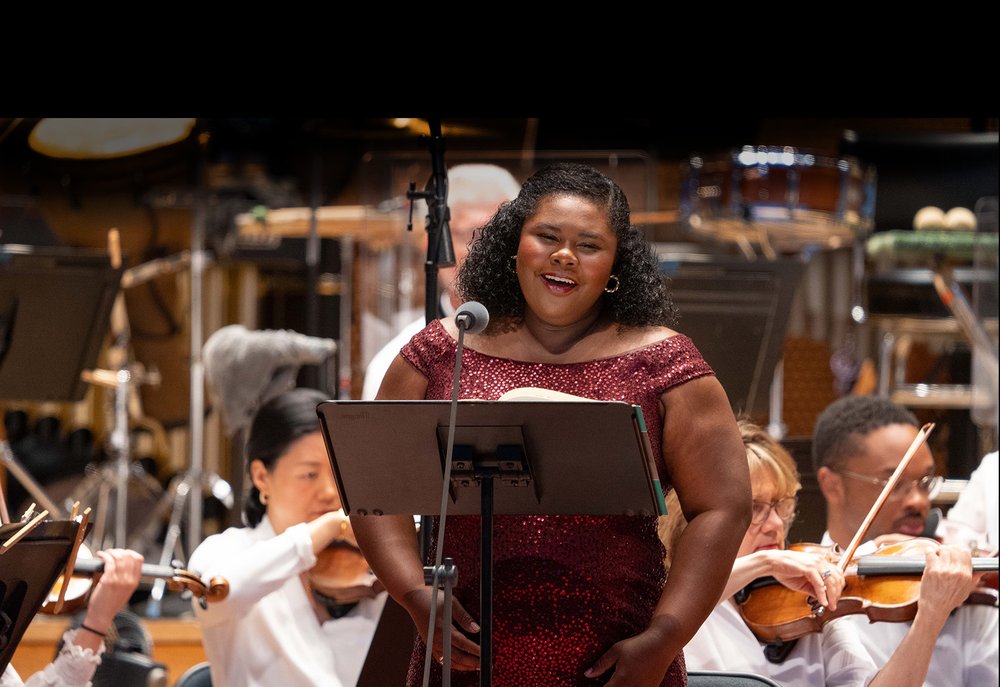
Lindsey Reynolds, soprano
Program Notes
Lili Boulanger (1893-1918)
D’un matin de printemps (1918)
Scored for: three flutes including piccolo, three oboes including English Horn, three clarinets including bass clarinet, three bassoons, four French horns, three trumpets, three trombones, tuba, percussion, harp, celesta, and strings
Performance time: 5 minutes
First Grant Park Orchestra performance
The story of Lili Boulanger is both inspiring and tragic. Born to a musical family, the talented musician composed a number of masterworks during her short life before passing away at twenty-four. Her older sister, Nadia, who eventually became one of the most influential composition teachers of the twentieth century, claimed her sister was “the first important woman composer.” Obviously, her statement is hyperbolic, but had Lili lived a full life, who knows what glass ceilings she could have broken.
After becoming the first woman to win the coveted Prix de Rome in 1913, Lili devoted what little time she had left to coming to terms with her failing health through composition. She had always been frail. Bronchial pneumonia as a child had weakened her immune system and led to a lifelong battle with Crohn’s disease. In 1917, Lili composed two short related works, D’un soir triste (“Of a Sad Evening”) and D’un matin de printemps (“Of a Spring Morning”), which Nadia helped transcribe as Lili’s health worsened. Given that Lili completed Of a Spring Morning just two months before she died, the work is surprisingly optimistic and vibrant. Demonstrating her own take on French Impressionism, the piece is replete with colorful wind writing for the winds and unique textures. For instance, the low opening flute solo is set against the tingling of the triangle and quietly thrumming strings. This charming melodic figure then passes between various wind instruments before building to a climax. Boulanger showcases remarkable variety within the scope of such a short piece, thinning the instrumentation to a chamber-like configuration before crescendoing to a cinematic finish, complete with harp glissando and orchestral pop.
This work was provided by the Edwin A. Fleisher Collection of Orchestral Music at the Free Library of Philadelphia.
Francis Poulenc (1899-1963)
Stabat Mater (1950)
Scored for: three flutes including piccolo, three oboes including English Horn, three clarinets including bass clarinet, three bassoons, four French horns, three trumpets, three trombones, tuba, timpani, two harps, strings, chorus, and solo soprano
Performance time: 31 minutes
First Grant Park Orchestra performance: July 27, 1977; Thomas Peck, conductor; Kathleen Battle, soprano
In August 1936, Francis Poulenc’s friend and fellow composer Pierre-Octave Ferroud died in a car accident. To process his grief, Poulenc made a pilgrimage to the ancient shrine of the Black Virgin at Notre-Dame de Rocamadour. The religious experience he had there was transformative, leading him back to the Roman Catholic faith of his childhood. Throughout the rest of his career, Poulenc produced a steady stream of sacred choral works. In 1950, Poulenc composed his largest-scale religious work to date, Stabat Mater. Again, the death of a friend—the painter and set designer Christian Bérard—spurred its composition. A liturgical Requiem setting seemed too formal and cold to memorialize a friend with whom Poulenc had attended costume balls and other entertainments. So, he turned to Stabat Mater, a thirteenth-century poem by Jacopone da Todi that has inspired numerous musical settings by composers from Pergolesi to Dvořák. While no less solemn than a Requiem, Stabat Mater depicts a more human expression of grief as Mary mourns the death of her son, Jesus, at the foot of the cross.
While similar to the later Gloria (1959) in configuration as a sacred concert work for mixed chorus, soprano soloist, and full orchestra, Stabat Mater is quite different in tone. This is not surprising given that the Gloria is a hymn of praise, whereas Stabat Mater is a meditation on Christ’s Passion. The greatest difference lies in Poulenc’s treatment of the choral forces. “My Stabat is an a capella chorus, while my Gloria is a large choral symphony,” he explained. Five of the twelve movements of Stabat Mater feature the chorus singing unaccompanied, and when the orchestra does appear, it is relatively restrained and deferential to the text. For instance, in “Fac, ut ardeat,” the orchestra only plays a short interlude between choral statements and punctuates the movement with a final chord. The texture of this movement is also paired down in its omission of the choral basses and stark polyphony.
Stabat Mater is driven by the drama inherent in the text. Poulenc combines the twenty stanzas of the original poem into twelve movements, perhaps in a nod to the twelve apostles. He captures the different moods of each stanza by employing varying textures, dynamics, and tempos within the span of one movement. For instance, in “Quis est homo, qui non fleret,” Poulenc paints the weeping of those who contemplate Mary’s suffering (“Is there anyone who would not weep upon seeing the Mother of Christ in such great distress?”) with anguished descending vocal lines over an agitated orchestra. Suddenly, the wailing stops as the choir whispers, “Quis? Quis?” (“Who? Who?”). The fury resumes as Poulenc portrays the flogging of Jesus with violent accents and slurred figures.
In typical Poulenc fashion, even the darkest texts are treated with touches of light, as in the blithe setting of “Quæ mœrebat.” While these sudden shifts in affect are not as pronounced as in the Gloria, they still reflect Poulenc’s famously dualistic nature as “half monk, half rascal.” To explain this hallmark of his musical character, Poulenc said, “[The French] realize that somberness and good humor are not mutually exclusive. Our composers, too, write profound music, but when they do, it is leavened with that lightness of spirit without which life would be unendurable.”
Nikolai Rimsky-Korsakov (1844-1908)
Scheherazade, op.35 (1888)
Scored for: three flutes including piccolo, two oboes including English Horn, two clarinets, two bassoons, four French horns, two trumpets, three trombones, tuba, timpani, percussion, harp, and strings
Performance time: 42 minutes
First Grant Park Orchestra performance: August 1, 1935; Eric DeLamarter, conductor
The collection of Middle Eastern folktales One Thousand and One Nights has inspired countless works of art and adaptations for over a millennium. Though its history is murky, the stories were likely collected and translated into Arabic from sources across North Africa and West, Central, and South Asia during the “Islamic Golden Age” of the eighth through fourteenth centuries. One Thousand and One Nights, colloquially known as Arabian Nights, features the following framing story: the cruel Sultan Shahryar believes all women are unfaithful. To enact his revenge on the entire sex, he takes a new wife each day, executing her the next morning before she has a chance to betray him. The cycle of violence finally breaks when he marries Scheherazade. A cunning woman, she saves herself by weaving enchanting tales of adventure, ending each night in the middle of a story to ensure her survival until the next day. She does this for 1,001 nights until the Sultan pardons her.
The work captured the European imagination when Antoine Gallard adapted and translated it for a French audience in the early 1700s. Russian composer Nicolai Rimsky-Korsakov (1844–1908) likely used Gallard’s version as inspiration for his most famous work, Scheherazade, written in 1888. Instead of telling specific stories from Arabian Nights, Rimsky-Korsakov scatters separate, unrelated episodes throughout the four movements. The connecting thread between them is the recurrence of the solo violin, which embodies Scheherazade, our intrepid narrator. Rimsky-Korsakov explained his intentions: “Developing the musical material quite freely, I had in view the creation of an orchestral suite in four movements, closely knit by the community of its themes and motifs, yet presenting, as it were, a kaleidoscope of fairy-tale images and designs of Oriental character.” Instead of distracting the listener with a specific program, Rimsky-Korsakov provides evocative titles for each movement to “direct the listeners’ fancy.”
Despite the lack of an explicit program, it is easy to hear the bombastic opening as a depiction of the brutal Sultan and the following violin solo as the flattering Scheherazade trying to save her skin. After the introduction of the work’s main characters, the first movement, titled “The Sea and Sinbad’s Ship,” paints a visceral picture of the churning sea (something Rimsky-Korsakov was intimately familiar with as a former naval officer) with a rocking cello accompaniment and chromatic melody in the violins. Scheherazade’s violin again opens the second movement, titled “The Story of the Kalendar Palace.” In this movement, Rimsky-Korsakov displays his brilliance as an orchestrator. His use of unique orchestral effects, such as the clarinet recitative over plucked strings, would directly influence composers such as Debussy and Ravel.
“The Young Price and the Young Princess” shows Rimsky-Korsakov at his most lyrical. Instead of introducing the movement, Scheherazade’s theme comes in the middle, as if a theatrical aside, then blends with the themes of the prince and the princess. The fourth movement carries the most descriptive and lengthy title: “Festival at Bagdad. The Sea. The Ships Break Against a Cliff Surmounted by a Bronze Horseman.” It opens like the first movement by depicting the contrast between the Sultan and Scheherazade. Melodies from the second and third movements recur during the festivities. Then, as the spectacle reaches its zenith, the stormy sea music from the first movement rolls in. Scheherazade’s solo emerges from the ensuing shipwreck, soaring into the stratosphere, finally freed from the Sultan’s tyrannical clutches.
Program Notes by Katherine Buzard
Event Sponsors
This program is generously sponsored by Colleen and Lloyd Fry and the Lloyd A. Fry Foundation and supported as part of the Dehmlow Choral Music Series.
The appearance of Lindsey Reynolds is graciously made possible with support from the David H. Whitney and Juliana Y. Chyu Next Generation Vocalist Fund.
Artistic Leadership

Support The Festival


Grant Park Orchestra
* denotes leave-of-absence † one-year position
Jeremy Black, concertmaster
Jennifer Cappelli
Injoo Choi
Dima Dimitrova
Erica Hudson
Hyewon Kim
Matthew Lehmann
Jayna Park
Rika Seko
Karen Sinclair
Bonnie Terry
Trista Wong
Jonathan Yi
Krzysztof Zimowski
Liba Shacht, principal
Laura Miller, assistant principal
Ying Chai
Ran Cheng
Karl Davies
Likai He
Tiffany Kang
Ann Lehmann
Cristina Muresan
Kjersti Nostbakken
Irene Radetzky
Jeanine Wynton
Thomas Yang
Terri Van Valkinburgh, principal
Yoshihiko Nakano, assistant principal
Patrick Brennan*
Elizabeth Breslin
Beatrice Chen
Amy Hess
Christopher McKay†
Rebecca Swan
Chloé Thominet
Walter Haman, principal
Peter Szczepanek, assistant principal
Calum Cook
Larry Glazier
Steven Houser
Eric Kutz
Eran Meir
Linc Smelser*
Colin Corner, principal
Peter Hatch, assistant principal
Andrew Anderson
Alexander Horton
Christian Luevano†
Isaac Polinksy†
Timothy Shaffer*
Chunyang Wang
Chris White
Mary Stolper, principal
Jennifer Debiec Lawson, assistant principal
Jennifer Debiec Lawson
Alyce Johnson
Mitchell Kuhn, principal
Alex Liedtke
Anne Bach, assistant principal
Anne Bach
Dario Brignoli, principal
Trevor O’Riordan
Eric Hall, principal
Nicole Haywood, assistant principal
William Ramos
Jonathan Boen, principal
Stephanie Blaha, assistant principal*
Fritz Foss†
Samuel Hamzem†
Brett Hodge*
Neil Kimel
David Gordon, principal
Mike Brozick, acting assistant principal
Michael Brozick
William Denton
Daniel Cloutier, principal*
Jeremy Moeller, acting principal
Alexander Mullins
Andrew Smith, principal
Daniel Karas, principal
Josh Jones, principal
Joel Cohen, assistant principal
Doug Waddell
Kayo Ishimaru-Fleisher, principal
Christopher Guzman
Alba Layana Izurieta, Violin
Janani Sivakumar, Violin
Harper Randolph, Viola
Gabriel Hightower, Cello
Grant Park Chorus
* denotes leave-of-absence † one-year position
Taylor Adams
Summer Aebker
Kristina Bachrach
Madalynn Baez
Megan E. Bell
Alyssa Bennett
Anna Joy Buegel
Laura Bumgardner
Elisabeth Burmeister
Katherine Buzard
Bethany Clearfield
Nathalie Colas
Corinne Costell
Carolyne DalMonte
Rebecca Fitzpatrick
Megan Fletcher
Kaitlin Foley
Saira Frank
Katherine Gray-Noon
Kimberly Gunderson
Alexandra Ioan
Alexandra Kassouf
Darlene Kelsey
Olivia Knutsen
Marybeth Kurnat
Catherine Larson
Katelyn Lee
Rosalind Lee
Rena Maduro
Hannah Dixon McConnell
Marie McManama
Meganna Miller
Kathleen Monson
Emily Mwila
Susan Nelson
Evangeline Ng
Karen R. Nussbaum
Máire O’Brien
Laura Perkett
Molly Phelan
Angela Presutti Korbitz
Alexia Rivera
Veronica Samiec
Whitney Shurtliff
Emily Sinclair
Tiana Sorenson
Christine Steyer
Diana Stoic
Karlie Traversa
Sarah van der Ploeg
Lydia Walsh-Rock
Sherry Watkins
Tara Wheeker
Emily Lyday Yiannias
Christina Adams
Melissa Arning
Christina Bernardoni
Christine Boddicker
Bethany Brewer
Jean Broekhuizen
Anna De Ocampo Kain
Julie DeBoer
Leah Dexter
Katrina Dubbs
Stacy Eckert
Margaret Fox
Elizabeth Frey
Liana German
Catarine Hancock
Ruth Ginelle Heald
Nina Heebink
Miya Higashiyama
Carla Janzen
Amy Allyssa Johnson
Kathryn Kinjo Duncan
Amanda Koopman
Jeannette Lee
Hannah Little
Thereza Lituma
Chelsea Lyons
Victoria Marshall
Jessica McCarthy
Greta McNamee
Quinn Middleman
Sarah Ponder
Emily Price
Lauren Randolph
Grace Ryan
Stephanie Schoenhofer
Suzanne A. Shields
Emlynn Shoemaker
Cassidy Smith
Emma Sorenson
Aidan Spencer
Alannah Spencer
Carolyn Sundlof Boudreau
Gabrielle Timofeev López
Corinne Wallace-Crane
A.J. Wester
Debra Wilder
Pamela Williams
Avery Winick
Enrico Giuseppe Bellomo
Justin Berkowitz
Madison Bolt
Eric Botto
Hoss Brock
Steven Caldicott Wilson
Joseph Cloonan
Damon Cole
John J. Concepción
Matthew Cummings
Micah A. Dingler
Howard Eckdahl
Jared V. Esguerra
Andrew Fisher
Ryan Frenk
Ace Gangoso
Klaus Georg
Nikhil Harle
Jianghai Ho
Max Hosmer
Cameo T. Humes
Paul Hunter
Garrett Johannsen
William Johnson
James Judd
Tejas Kishan Gururaja
Tim Lambert
Tyler Lee
Mason Montuoro
Stephen D. Noon
Brett Potts
Nicholas Pulikowski
Brian Rasmussen
Patrick Reardon
Peder Reiff
Matthew W. Schlesinger
Silfredo Serrano
Joe Shadday
Aaron Short
Matthew Sink
Brian Skoog
Michael St. Peter
Ryan Townsend Strand
Brett Sweeney
Alan Taylor
Keven Washburn
Sean J. Watland
Walter Aldrich
Evan Bravos
Matthew Brennan
Tabes Bridges
Michael Cavalieri
Stephen Clark
David Corlew
Michael D. Costello
Philip Courington
Ryan J. Cox
Ed Frazier Davis
Wesley Diener
Chris DiMarco
Christopher Filipowicz
Gabriel Garcia
Dimitri German
Dominic German
David Govertsen
David Hartley
Matthew Hunt
Brian Hupp
Jan Jarvis
Jess Koehn
Zachary Mendenhall
Eric Miranda
Ron Mitchell
Ian Morris
Ian Murrell
Chiemerie Obianom
John E. Orduña
Wilbur Pauley
Douglas Peters
Jackson Pierzina
Anthony Pilcher
Martin Lowen Poock
Ian Prichard
Gabriel Reitemeier
Dan Richardson
Stephen Richardson
Benjamin D. Rivera
Joseph Ryan
Ivo Suarez
Avery Sujkowski
Scott Uddenberg
Vince Wallace
Nicholas Ward
Aaron Wardell
Ronald Watkins
Jonathon Weller
Peter Wesoloski
Max Wier
Jonathan Wilson
Chuck Foster
John Goodwin
Veronica Mak, soprano
Emily Amesquita, alto
Alexi Ortega Chavez, tenor
Lifan Deng, bass