Shostakovich Symphony No. 5
Program
JOAN TOWER 1920/2019
DMITRI SHOSTAKOVICH Symphony No. 5
Moderato
Allegretto
Largo
Allegro non troppo
Featuring
Grant Park Orchestra
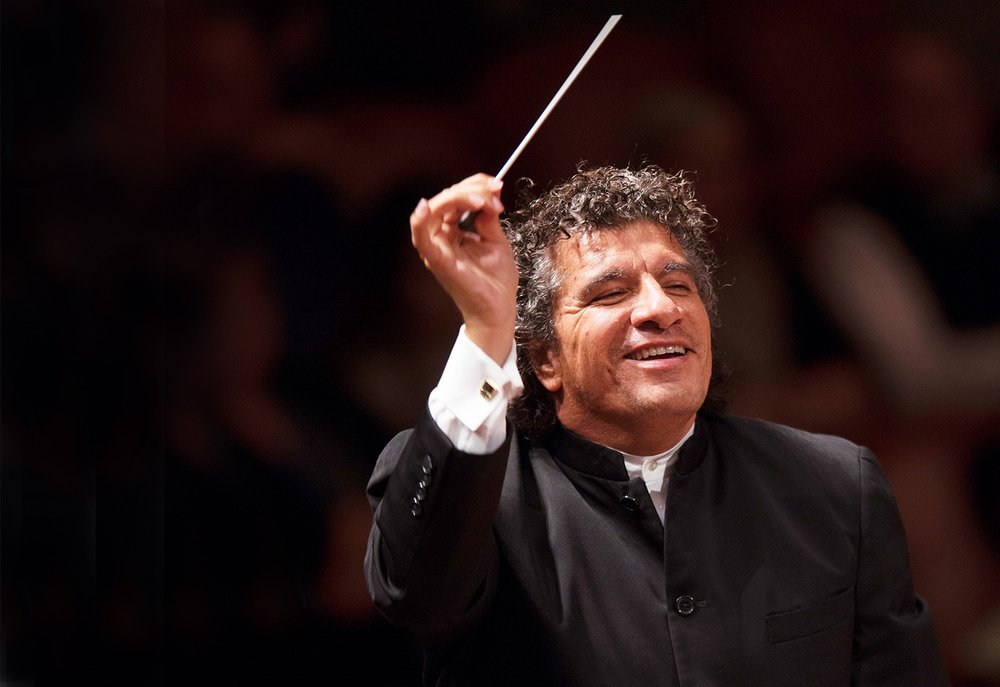
Giancarlo Guerrero, conductor
Program Notes
Joan Tower (b. 1938)
1920/2019
Scored for: two flutes including piccolo, two oboes, two clarinets, two bassoons, four French horns, two trumpets, three trombones, tuba, timpani, percussion, piano, and strings
Performance time: 14 minutes
First Grant Park Orchestra performance
Joan Tower is widely considered one of the most important American composers working today. She has received numerous accolades for her six-decade career as a composer, performer, and educator, including the League of American Orchestra’s highest honor, the Gold Baton, in 2019. That same year, the New York Philharmonic commissioned Tower to compose a piece as part of the orchestra’s Project 19. Spearheaded by the orchestra’s president and CEO, Deborah Borda, the initiative set out to commission and premiere nineteen new works by women composers in honor of the 2020 centennial of the passage of the Nineteenth Amendment, which enshrined women’s right to vote in the United States Constitution. To date, Project 19 is the single largest commission project for female composers in history. Tower dedicated 1920/2019 to Borda in recognition of her visionary leadership.
In composing 1920/2019, Tower took inspiration from the premise of the commission itself. “I began writing this music in 2019 as the #MeToo movement continued to grow,” she explains in her program note. “Victims of sexual abuse, assault, and harassment are ending their silence, finding strength by sharing their experiences and beliefs. These two years—1920 and 2019—were probably the two most historically significant years for the advancement of women in society.” While nothing in the work points to any specific events in the fight for women’s rights over the last century, the recurring five-note rising motif and other ascending figures amid blocks of heavy chords signify a constant struggle upwards. Tower contrasts the density of the opening theme with sparser sections that highlight different solo instruments, including those within the percussion section. Tower has long been fascinated by percussion—a fascination she credits to her upbringing in Bolivia. Her nanny would take her to patron saint festivals and drop her off by the bandstand, where the musicians would hand her maracas or castanets to play. Tower explains that 1920/2019 is “largely about rhythm and texture…set in a dramatic and organic narrative.” Regardless of any programmatic intent, it is difficult not to hear the final floating violin solo as optimistic about the future.
Dmitri Shostakovich (1906-1975)
Symphony No.5 in D minor, op.47 (1937)
Scored for: three flutes including piccolo, two oboes, three clarinets including bass clarinet, three bassoons including contrabassoon, four French horns, three trumpets, three trombones, tuba, timpani, percussion, harp, piano, celesta, and strings
Performance time: 44 minutes
First Grant Park Orchestra performance: June 28, 1961; Milton Katims, conductor
That Dmitri Shostakovich managed to produce one of the greatest symphonies of the twentieth century while fearing for his career, or worse, his life, is a testament to the composer’s resilience. He had to navigate wild fluctuations in his reputation throughout his career. The premiere of his First Symphony at just nineteen years old had catapulted him to international fame and accorded him official favor. However, Joseph Stalin’s purges during the Great Terror of the mid-1930s put Shostakovich, as the most prominent Soviet composer, under increased scrutiny. In January 1936, Stalin attended a new production of Shostakovich’s acclaimed 1934 opera, Lady Macbeth of Mtsensk. A few days later, an anonymous article in the Pravda, rumored to be at the behest of Stalin himself, condemned the opera as “Un-Soviet, unwholesome, cheap, eccentric, tuneless and leftist.” Many of Shostakovich’s fellow composers joined in the public denouncement to save their own skins.
The leveling of these criticisms amid the prevailing atmosphere of fear shook Shostakovich to his core. Several of his family members and artistic associates had been arrested during the purges. Some sources even claim he contemplated suicide. What sustained him was the arrival of his first child in May and ongoing work on his Fourth Symphony. In November, however, Shostakovich bowed to official pressure to withdraw his symphony shortly before the premiere, given its dissonant character and often manic energy. (It would not see performance until 1961.) He went back to the drawing board the following spring to work on a new symphony—one that would pass the Kremlin’s litmus test. When his Fifth Symphony premiered in November 1937, it received a thirty-minute ovation. The audience had wept openly during the sumptuous Largo movement in a mass exhalation of suppressed grief at the height of the Great Terror. The overwhelming success of Shostakovich’s Fifth Symphony marked his official “rehabilitation” and reaffirmed his status as a Soviet cultural hero. But he would never take that designation for granted again.
From 1936 onward, Shostakovich learned how to bend his aesthetics to adhere to the vague yet imperative stylistic demands of the Party while maintaining his creative integrity. This time also marks the emergence of the “two Shostakoviches,” one private and one public. He began to direct his public style toward the lyrical and heroic to appease the Kremlin while also incorporating hidden meanings that could subvert superficial interpretations. A master of satire, he learned how to blur the line between authenticity and irony so that he could remain above suspicion, largely leaving the subtext to the imagination of the listener.
Adding to this ambiguity is Shostakovich’s purported statements regarding his Fifth Symphony. He publicly endorsed an unnamed journalist’s assessment of the symphony as “a Soviet artist’s practical creative reply to just criticism.” (The source of this quote has not been confirmed; Shostakovich may have put it forth himself to assert his successful rehabilitation.) However, in his potentially specious memoirs, Testimony, published posthumously in 1979, Shostakovich said of the finale, “The rejoicing is forced, created under threat…It’s as if someone were beating you with a stick and saying, ‘Your business is rejoicing, your business is rejoicing.’” Cunningly, a musical reference in the finale supports both the private and the public reading. Shostakovich quotes the accompanimental figure and opening vocal motif of the song “Rebirth” from his Four Romances of Poems by Pushkin, written in December 1936. While the title is a nod to Shostakovich’s own renewal, the text of the song is about the permanence of art despite the willful interference of a “barbarian.” Regardless of whether listeners picked up on this reference or others within the epic score, the triumphant tone of the brassy, major-key finale was enough to convince Soviet critics that it was acceptable to express tragic emotions, as in the Largo, so long as the ending was sufficiently upbeat.
Event Sponsor
The appearance of Giancarlo Guerrero is generously underwritten by Lori Julian for the Julian Family Foundation.
Artistic Leadership

Support The Festival
Grant Park Orchestra
* denotes leave-of-absence † one-year position
Jeremy Black, concertmaster
Jennifer Cappelli
Injoo Choi
Dima Dimitrova
Erica Hudson
Hyewon Kim
Matthew Lehmann
Jayna Park
Rika Seko
Karen Sinclair
Bonnie Terry
Trista Wong
Jonathan Yi
Krzysztof Zimowski
Liba Shacht, principal
Laura Miller, assistant principal
Ying Chai
Ran Cheng
Karl Davies
Likai He
Tiffany Kang
Ann Lehmann
Cristina Muresan
Kjersti Nostbakken
Irene Radetzky
Jeanine Wynton
Thomas Yang
Terri Van Valkinburgh, principal
Yoshihiko Nakano, assistant principal
Patrick Brennan*
Elizabeth Breslin
Beatrice Chen
Amy Hess
Christopher McKay†
Rebecca Swan
Chloé Thominet
Walter Haman, principal
Peter Szczepanek, assistant principal
Calum Cook
Larry Glazier
Steven Houser
Eric Kutz
Eran Meir
Linc Smelser*
Colin Corner, principal
Peter Hatch, assistant principal
Andrew Anderson
Alexander Horton
Christian Luevano†
Isaac Polinksy†
Timothy Shaffer*
Chunyang Wang
Chris White
Mary Stolper, principal
Jennifer Debiec Lawson, assistant principal
Jennifer Debiec Lawson
Alyce Johnson
Mitchell Kuhn, principal
Alex Liedtke
Anne Bach, assistant principal
Anne Bach
Dario Brignoli, principal
Trevor O’Riordan
Eric Hall, principal
Nicole Haywood, assistant principal
William Ramos
Jonathan Boen, principal
Stephanie Blaha, assistant principal*
Fritz Foss†
Samuel Hamzem†
Brett Hodge*
Neil Kimel
David Gordon, principal
Mike Brozick, acting assistant principal
Michael Brozick
William Denton
Daniel Cloutier, principal*
Jeremy Moeller, acting principal
Alexander Mullins
Andrew Smith, principal
Daniel Karas, principal
Josh Jones, principal
Joel Cohen, assistant principal
Doug Waddell
Kayo Ishimaru-Fleisher, principal
Christopher Guzman
Alba Layana Izurieta, Violin
Janani Sivakumar, Violin
Harper Randolph, Viola
Gabriel Hightower, Cello
Grant Park Chorus
* denotes leave-of-absence † one-year position
Taylor Adams
Summer Aebker
Kristina Bachrach
Madalynn Baez
Megan E. Bell
Alyssa Bennett
Anna Joy Buegel
Laura Bumgardner
Elisabeth Burmeister
Katherine Buzard
Bethany Clearfield
Nathalie Colas
Corinne Costell
Carolyne DalMonte
Rebecca Fitzpatrick
Megan Fletcher
Kaitlin Foley
Saira Frank
Katherine Gray-Noon
Kimberly Gunderson
Alexandra Ioan
Alexandra Kassouf
Darlene Kelsey
Olivia Knutsen
Marybeth Kurnat
Catherine Larson
Katelyn Lee
Rosalind Lee
Rena Maduro
Hannah Dixon McConnell
Marie McManama
Meganna Miller
Kathleen Monson
Emily Mwila
Susan Nelson
Evangeline Ng
Karen R. Nussbaum
Máire O’Brien
Laura Perkett
Molly Phelan
Angela Presutti Korbitz
Alexia Rivera
Veronica Samiec
Whitney Shurtliff
Emily Sinclair
Tiana Sorenson
Christine Steyer
Diana Stoic
Karlie Traversa
Sarah van der Ploeg
Lydia Walsh-Rock
Sherry Watkins
Tara Wheeker
Emily Lyday Yiannias
Christina Adams
Melissa Arning
Christina Bernardoni
Christine Boddicker
Bethany Brewer
Jean Broekhuizen
Anna De Ocampo Kain
Julie DeBoer
Leah Dexter
Katrina Dubbs
Stacy Eckert
Margaret Fox
Elizabeth Frey
Liana German
Catarine Hancock
Ruth Ginelle Heald
Nina Heebink
Miya Higashiyama
Carla Janzen
Amy Allyssa Johnson
Kathryn Kinjo Duncan
Amanda Koopman
Jeannette Lee
Hannah Little
Thereza Lituma
Chelsea Lyons
Victoria Marshall
Jessica McCarthy
Greta McNamee
Quinn Middleman
Sarah Ponder
Emily Price
Lauren Randolph
Grace Ryan
Stephanie Schoenhofer
Suzanne A. Shields
Emlynn Shoemaker
Cassidy Smith
Emma Sorenson
Aidan Spencer
Alannah Spencer
Carolyn Sundlof Boudreau
Gabrielle Timofeev López
Corinne Wallace-Crane
A.J. Wester
Debra Wilder
Pamela Williams
Avery Winick
Enrico Giuseppe Bellomo
Justin Berkowitz
Madison Bolt
Eric Botto
Hoss Brock
Steven Caldicott Wilson
Joseph Cloonan
Damon Cole
John J. Concepción
Matthew Cummings
Micah A. Dingler
Howard Eckdahl
Jared V. Esguerra
Andrew Fisher
Ryan Frenk
Ace Gangoso
Klaus Georg
Nikhil Harle
Jianghai Ho
Max Hosmer
Cameo T. Humes
Paul Hunter
Garrett Johannsen
William Johnson
James Judd
Tejas Kishan Gururaja
Tim Lambert
Tyler Lee
Mason Montuoro
Stephen D. Noon
Brett Potts
Nicholas Pulikowski
Brian Rasmussen
Patrick Reardon
Peder Reiff
Matthew W. Schlesinger
Silfredo Serrano
Joe Shadday
Aaron Short
Matthew Sink
Brian Skoog
Michael St. Peter
Ryan Townsend Strand
Brett Sweeney
Alan Taylor
Keven Washburn
Sean J. Watland
Walter Aldrich
Evan Bravos
Matthew Brennan
Tabes Bridges
Michael Cavalieri
Stephen Clark
David Corlew
Michael D. Costello
Philip Courington
Ryan J. Cox
Ed Frazier Davis
Wesley Diener
Chris DiMarco
Christopher Filipowicz
Gabriel Garcia
Dimitri German
Dominic German
David Govertsen
David Hartley
Matthew Hunt
Brian Hupp
Jan Jarvis
Jess Koehn
Zachary Mendenhall
Eric Miranda
Ron Mitchell
Ian Morris
Ian Murrell
Chiemerie Obianom
John E. Orduña
Wilbur Pauley
Douglas Peters
Jackson Pierzina
Anthony Pilcher
Martin Lowen Poock
Ian Prichard
Gabriel Reitemeier
Dan Richardson
Stephen Richardson
Benjamin D. Rivera
Joseph Ryan
Ivo Suarez
Avery Sujkowski
Scott Uddenberg
Vince Wallace
Nicholas Ward
Aaron Wardell
Ronald Watkins
Jonathon Weller
Peter Wesoloski
Max Wier
Jonathan Wilson
Chuck Foster
John Goodwin
Veronica Mak, soprano
Emily Amesquita, alto
Alexi Ortega Chavez, tenor
Lifan Deng, bass