Tetzlaff Plays Elgar
Program
Edward Elgar - Violin Concerto
Allegro
Andante
Allegro molto
INTERMISSION
Gustav Holst - The Cloud Messenger
Featuring
Grant Park Orchestra
Grant Park Chorus
Carlos Kalmar, conductor
Christopher Bell, chorus director
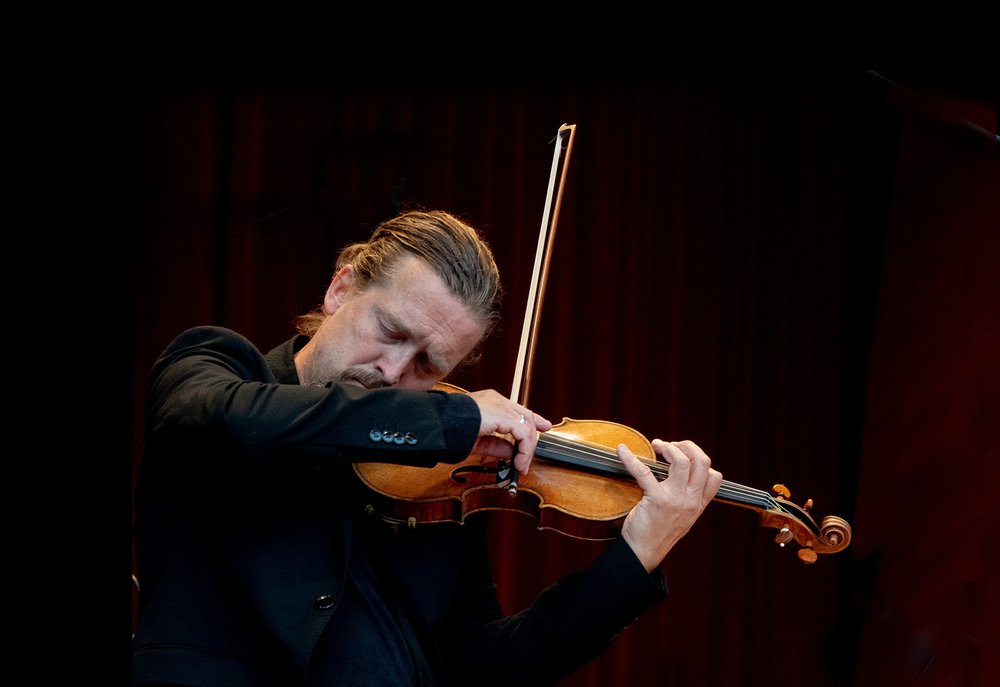
Christian Tetzlaff, violin
Lauren Decker, contralto
Program Notes
Edward Elgar (1857-1934)
Concerto in B minor for Violin & Orchestra, op.61 (1909)
Scored for: two flutes, two oboes, two clarinets, three bassoons including contrabassoon, four French horns, two trumpets, three trombones, tuba, timpani, strings, and solo violin
Performance time: 48 minutes
First Grant Park Orchestra performance
British composer Edward Elgar had a penchant for puzzles and ciphers and understood their power in drumming up publicity for his compositions. The most famous example is Elgar’s Variations on an Original Theme, Op. 36, popularly known as the Enigma Variations. Each of the fourteen movements presents a musical sketch of a person in his life. These figures are not explicitly stated, but scholars have decoded the hidden muses. For instance, the most famous movement, “Nimrod,” is a nod to Elgar’s publisher Augustus Jaeger (“Jaeger” being the German word for “hunter” and “Nimrod” being a hunter in the Bible). In addition to these musical characterizations, Elgar claims to have hidden an “Enigma” deep within the piece—that another famous piece of music is a musical counterpoint to the work’s theme. Numerous solutions have been proposed, but we will likely never know the definite answer, if there even is one.
In a similar vein, Elgar deliberately created an air of mystery around his Violin Concerto in B Minor by inscribing it with the words, “Aquí está encerrada el alma de…..” (“Herein is enshrined the soul of…..”). These five dots have spurred as much discussion as the music itself. One theory posits that it references his friend Alice Stuart-Wortley, whom he called “Windflower” to avoid confusion with his wife, also named Alice. Alice knew her husband’s “friendships” with younger women and may have even encouraged them to fuel his creativity. He wrote to Windflower throughout the agonizing compositional process and even peppered the score with so-called “Windflower themes,” namely, the gentle second subject of the first movement. Regardless of the dedicatee(s), there are multiple musical allusions throughout the concerto that only Elgar and a select few understood.
The Violin Concerto in B Minor opens with a long orchestral exposition. Bursts of short musical ideas churn as Elgar avoids defining the key. The second theme, full of pathos, builds in anticipation of the violin soloist’s entrance. The soloist restates the opening melody, finally ushering in some harmonic resolution. What ensues is contemplative but still restless. The transformation and recombination of the previous themes bring the movement to a powerful conclusion.
After the gentle opening of the Andante, the soloist introduces a plaintive melody in the violin’s middle register. The movement is generally more static than the opening Allegro movement but still traverses various harmonic realms. If you listen carefully, you might spot one of Elgar’s musical allusions: the distinctive “Tristan chord” that opens Wagner’s Tristan und Isolde. After a virtuosic leaping phrase, the violin lands on the soft bed of the Tristan chord in the low brass, which recurs a few moments later under the violin’s ascending chromatic scale.
In the finale, the suppressed tension of the Andante bubbles to the surface. The soloist proceeds with even greater virtuosity as themes whiz past. But this is all in preparation for the emotional center of the concerto: the cadenza. The extensive accompanied cadenza recalls themes from the previous movements. The soloist then completes the orchestra’s restatement of the opening bars, bringing the piece full circle.
Gustav Holst (1874-1934)
The Cloud Messenger
Scored for: three flutes including piccolo, three oboes including English Horn, three clarinets including bass clarinet, three bassoons including contrabassoon, four French horns, three trumpets, three trombones, tuba, timpani, percussion, harp, celesta, organ, strings, chorus, and solo contralto
Performance time: 43 minutes
First Grant Park Orchestra performance
Before Gustav Holst looked to astrology for his most famous work, The Planets, he had another source of inspiration: Sanskrit literature. From 1895 to 1910, Holst composed many works derived from Indian mythology and subject matter, including two operas (Sita and Sāvitri), a symphonic poem (Indra), numerous settings of Vedic Sanskrit hymns, and the cantata The Cloud Messenger. His fascination paralleled the West’s increasing awareness of Indian art, literature, and philosophy, driven in part by world’s fairs. Published in 1895 to coincide with the Empire of India Exhibition in London, R. W. Frazer’s Silent Gods and Sun-Steeped Lands spurred Holst’s interest in India. In the book, Frazer argues that the fusion of Western and Eastern philosophies would lead to moral and intellectual advancement for all humanity. It also introduced Holst to the lyric poem Meghadūta (The Cloud Messenger) by the fifth-century poet Kālidāsa.
With a few Sanskrit lessons under his belt, Holst began translating the poem and composing music for it in 1903. The process took seven years, plus two years of revisions, before the belated 1913 premiere. Holst based his translation on the story presented in Frazer’s book and made some edits for British sensibilities, excising some of the more overt eroticism. In the story, a yaksha, or nature spirit, has been banished by his master, Kubera, the god of wealth, for neglecting his duties. He sees a cloud floating northward toward home and asks it to convey a message of love and comfort to his wife, saying they will soon be reunited.
The long orchestral prologue introduces the leitmotifs of the yaksha, his wife, and the passing cloud. Holst’s use of leitmotifs and chromaticism point to Wagner’s profound influence on his early works. However, in this piece, Holst starts to find his unique voice, showing glimmers of what is to come in The Planets. Exploring a foreign culture emboldened him to pursue new musical ideas. For instance, Holst’s direct and homophonic choral writing is miles away from the denser textures of 19th-century British choral music and allows the words to be understood. He also turns away from traditional symphonic development of musical ideas, instead juxtaposing them as if in a mosaic.
Holst considered The Cloud Messenger his most important work to date, making the shambles that was the premiere even harder to bear. Through some massive oversight, organizers neglected to hire the semi-chorus in time for rehearsals, forcing the singers sight-read the last eight minutes. The performance was a disaster. After this shoddy first outing, the score to The Cloud Messenger fell out of circulation, and the piece languished for decades. After The Cloud Messenger fiasco, Holst lost interest in composing music based on Indian themes.
Program Notes by Katherine Buzard
Event Sponsors
This program is generously supported as part of the Dehmlow Choral Music Series. The appearance of Lauren Decker is graciously made possible with support from the David H. Whitney and Juliana Y. Chyu Next Generation Vocalist Fund. Organ provided by Triune Music/S.B. Smith & Associates.
Artistic Leadership

Support The Festival
Grant Park Orchestra
* denotes leave-of-absence † one-year position
Jeremy Black, concertmaster
Jennifer Cappelli
Injoo Choi
Dima Dimitrova
Erica Hudson
Hyewon Kim
Matthew Lehmann
Jayna Park
Rika Seko
Karen Sinclair
Bonnie Terry
Trista Wong
Jonathan Yi
Krzysztof Zimowski
Liba Shacht, principal
Laura Miller, assistant principal
Ying Chai
Ran Cheng
Karl Davies
Likai He
Tiffany Kang
Ann Lehmann
Cristina Muresan
Kjersti Nostbakken
Irene Radetzky
Jeanine Wynton
Thomas Yang
Terri Van Valkinburgh, principal
Yoshihiko Nakano, assistant principal
Patrick Brennan*
Elizabeth Breslin
Beatrice Chen
Amy Hess
Christopher McKay†
Rebecca Swan
Chloé Thominet
Walter Haman, principal
Peter Szczepanek, assistant principal
Calum Cook
Larry Glazier
Steven Houser
Eric Kutz
Eran Meir
Linc Smelser*
Colin Corner, principal
Peter Hatch, assistant principal
Andrew Anderson
Alexander Horton
Christian Luevano†
Isaac Polinksy†
Timothy Shaffer*
Chunyang Wang
Chris White
Mary Stolper, principal
Jennifer Debiec Lawson, assistant principal
Jennifer Debiec Lawson
Alyce Johnson
Mitchell Kuhn, principal
Alex Liedtke
Anne Bach, assistant principal
Anne Bach
Dario Brignoli, principal
Trevor O’Riordan
Eric Hall, principal
Nicole Haywood, assistant principal
William Ramos
Jonathan Boen, principal
Stephanie Blaha, assistant principal*
Fritz Foss†
Samuel Hamzem†
Brett Hodge*
Neil Kimel
David Gordon, principal
Mike Brozick, acting assistant principal
Michael Brozick
William Denton
Daniel Cloutier, principal*
Jeremy Moeller, acting principal
Alexander Mullins
Andrew Smith, principal
Daniel Karas, principal
Josh Jones, principal
Joel Cohen, assistant principal
Doug Waddell
Kayo Ishimaru-Fleisher, principal
Christopher Guzman
Alba Layana Izurieta, Violin
Janani Sivakumar, Violin
Harper Randolph, Viola
Gabriel Hightower, Cello
Grant Park Chorus
* denotes leave-of-absence † one-year position
Taylor Adams
Summer Aebker
Kristina Bachrach
Madalynn Baez
Megan E. Bell
Alyssa Bennett
Anna Joy Buegel
Laura Bumgardner
Elisabeth Burmeister
Katherine Buzard
Bethany Clearfield
Nathalie Colas
Corinne Costell
Carolyne DalMonte
Rebecca Fitzpatrick
Megan Fletcher
Kaitlin Foley
Saira Frank
Katherine Gray-Noon
Kimberly Gunderson
Alexandra Ioan
Alexandra Kassouf
Darlene Kelsey
Olivia Knutsen
Marybeth Kurnat
Catherine Larson
Katelyn Lee
Rosalind Lee
Rena Maduro
Hannah Dixon McConnell
Marie McManama
Meganna Miller
Kathleen Monson
Emily Mwila
Susan Nelson
Evangeline Ng
Karen R. Nussbaum
Máire O’Brien
Laura Perkett
Molly Phelan
Angela Presutti Korbitz
Alexia Rivera
Veronica Samiec
Whitney Shurtliff
Emily Sinclair
Tiana Sorenson
Christine Steyer
Diana Stoic
Karlie Traversa
Sarah van der Ploeg
Lydia Walsh-Rock
Sherry Watkins
Tara Wheeker
Emily Lyday Yiannias
Christina Adams
Melissa Arning
Christina Bernardoni
Christine Boddicker
Bethany Brewer
Jean Broekhuizen
Anna De Ocampo Kain
Julie DeBoer
Leah Dexter
Katrina Dubbs
Stacy Eckert
Margaret Fox
Elizabeth Frey
Liana German
Catarine Hancock
Ruth Ginelle Heald
Nina Heebink
Miya Higashiyama
Carla Janzen
Amy Allyssa Johnson
Kathryn Kinjo Duncan
Amanda Koopman
Jeannette Lee
Hannah Little
Thereza Lituma
Chelsea Lyons
Victoria Marshall
Jessica McCarthy
Greta McNamee
Quinn Middleman
Sarah Ponder
Emily Price
Lauren Randolph
Grace Ryan
Stephanie Schoenhofer
Suzanne A. Shields
Emlynn Shoemaker
Cassidy Smith
Emma Sorenson
Aidan Spencer
Alannah Spencer
Carolyn Sundlof Boudreau
Gabrielle Timofeev López
Corinne Wallace-Crane
A.J. Wester
Debra Wilder
Pamela Williams
Avery Winick
Enrico Giuseppe Bellomo
Justin Berkowitz
Madison Bolt
Eric Botto
Hoss Brock
Steven Caldicott Wilson
Joseph Cloonan
Damon Cole
John J. Concepción
Matthew Cummings
Micah A. Dingler
Howard Eckdahl
Jared V. Esguerra
Andrew Fisher
Ryan Frenk
Ace Gangoso
Klaus Georg
Nikhil Harle
Jianghai Ho
Max Hosmer
Cameo T. Humes
Paul Hunter
Garrett Johannsen
William Johnson
James Judd
Tejas Kishan Gururaja
Tim Lambert
Tyler Lee
Mason Montuoro
Stephen D. Noon
Brett Potts
Nicholas Pulikowski
Brian Rasmussen
Patrick Reardon
Peder Reiff
Matthew W. Schlesinger
Silfredo Serrano
Joe Shadday
Aaron Short
Matthew Sink
Brian Skoog
Michael St. Peter
Ryan Townsend Strand
Brett Sweeney
Alan Taylor
Keven Washburn
Sean J. Watland
Walter Aldrich
Evan Bravos
Matthew Brennan
Tabes Bridges
Michael Cavalieri
Stephen Clark
David Corlew
Michael D. Costello
Philip Courington
Ryan J. Cox
Ed Frazier Davis
Wesley Diener
Chris DiMarco
Christopher Filipowicz
Gabriel Garcia
Dimitri German
Dominic German
David Govertsen
David Hartley
Matthew Hunt
Brian Hupp
Jan Jarvis
Jess Koehn
Zachary Mendenhall
Eric Miranda
Ron Mitchell
Ian Morris
Ian Murrell
Chiemerie Obianom
John E. Orduña
Wilbur Pauley
Douglas Peters
Jackson Pierzina
Anthony Pilcher
Martin Lowen Poock
Ian Prichard
Gabriel Reitemeier
Dan Richardson
Stephen Richardson
Benjamin D. Rivera
Joseph Ryan
Ivo Suarez
Avery Sujkowski
Scott Uddenberg
Vince Wallace
Nicholas Ward
Aaron Wardell
Ronald Watkins
Jonathon Weller
Peter Wesoloski
Max Wier
Jonathan Wilson
Chuck Foster
John Goodwin
Veronica Mak, soprano
Emily Amesquita, alto
Alexi Ortega Chavez, tenor
Lifan Deng, bass