
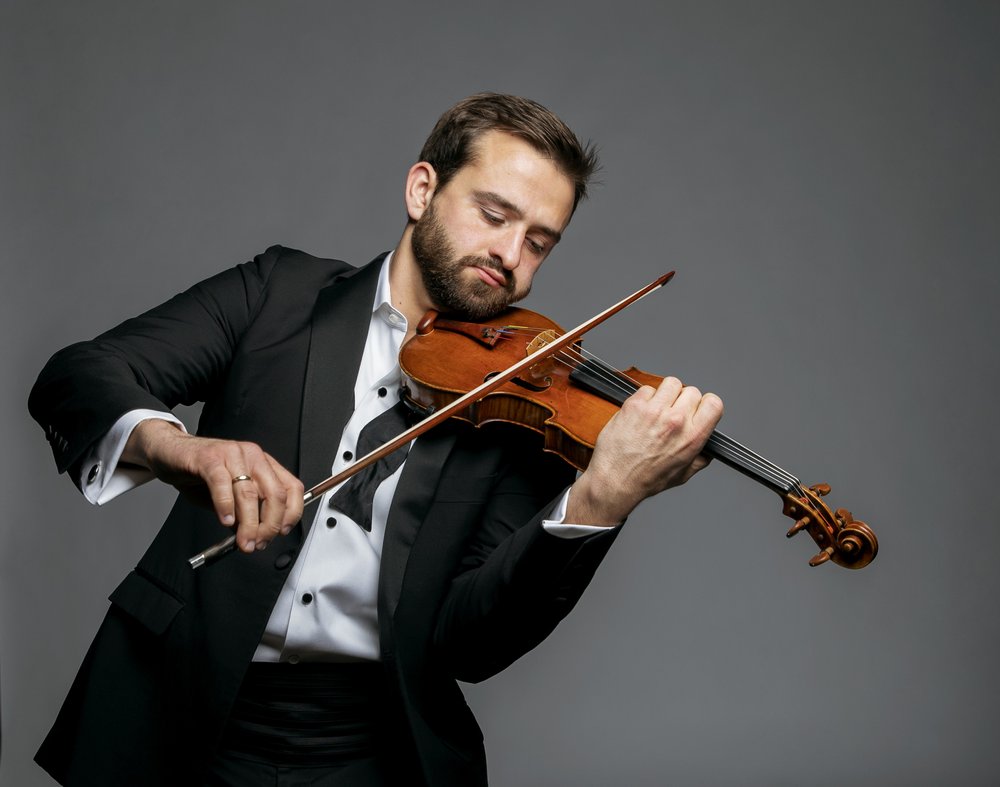
Barber Violin Concerto
Program
Jessie Montgomery Starburst (3 mins)
Samuel Barber Concerto for Violin and Orchestra, op. 14 (25 mins)
Allegro
Andante
Presto in moto perpetuo
Peter Boyer Ellis Island: The Dream of America (44 mins)
Prologue
Helen Cohen (emigrated from Poland, 1920)
Interlude 1
James Apanomith (Greece, 1911)
Interlude 2
Lillian Galletta (Italy, 1908)
Interlude 3
Lazarus Salamon (Hungary, 1920)
Interlude 4
Helen Rosenthal (Belgium, 1940)
Interlude 5
Manny Steen (Ireland, 1925)
Interlude 6
Katherine Beychok (Russia, 1910)
Epilogue: The New Colossus, by Emma Lazarus, 1883
Featuring

Program Notes
Jessie Montgomery (b. 1981)
Starburst (2012)
Scored for: strings
Performance time: 3 minutes
First Grant Park Orchestra performance.
In the field of astronomy, a starburst is the sudden formation of vast quantities of stars. The rate and volume of creation is so high that it alters the structure of the entire galaxy. Composer Jessie Montgomery evokes this flurry of energy in Starburst, a short one-movement work for string orchestra. She creates a multidimensional soundscape by mixing explosive, syncopated phrases with fleet-footed runs and undulations to capture what she calls the “imagery of rapidly shifting colors.” Starburst was commissioned in 2012 by The Sphinx Organization, a Detroit-based nonprofit dedicated to increasing the representation of Black and Latinx artists in classical music. The organization’s groundbreaking chamber orchestra, The Sphinx Virtuosi, inspired the imagery of the piece and gave the work’s premiere.
—Katherine Buzard
Samuel Barber (1910-1981)
Concerto for Violin and Orchestra, op. 14 (1939)
Scored for: two flutes including piccolo, two oboes, two clarinets, two bassoons, two French horns, two trumpets, timpani, piano, solo violin, and strings
Performance time: 25 minutes
First Grant Park Orchestra performance: Jul 24, 1963; Theodore Bloomfield, conductor; Jaime Laredo, violin
In May 1939, Samuel Barber received his first major commission. Little did he know the drama that would ensue. Samuel Simeon Fels, a Philadelphia businessman and arts patron, commissioned Barber to compose a violin concerto for Iso Briselli, his ward, to perform with the Philadelphia Orchestra the following January. Barber was to be paid $1,000 for the concerto—$500 up front and $500 upon completion, which was considered decent pay for a young composer. Briselli, a violin prodigy from Odessa, was brought to the United States at age 12 by his violin teacher, Carl Flesch, who had accepted a position as head of the violin department at the newly established Curtis Institute. Briselli lived with the Fels family and studied at Curtis alongside Barber, both graduating in 1934.
Barber began composing the first two movements while in Switzerland in August 1939. However, the mounting threat of war forced him and his compatriots to leave Europe in haste in early September. He completed the first two movements back home in the Poconos and sent them off to Briselli in mid-October. Briselli was pleased with what Barber had written so far but asked for more virtuosic violin writing in the finale. Briselli’s coach, Albert Meiff, was less enthusiastic when he saw the score. He wrote to Fels that the violin part needed substantial reworking by a “specialist” such as himself and thought it would harm Briselli’s reputation to perform the work because “The technical embellishments are very far from the requirements of a modern violinist,” he said. He offered to meet with Barber to help him compose the third movement, but Barber demurred.
Barber completed the third movement in November, giving Briselli the virtuosity he craved with a presto finale. Despite its numerous technical challenges, Briselli felt the finale was too lightweight and disconnected from the previous two movements. He asked Barber to rewrite it, but Barber refused, explaining in a letter to Fels, “I could not destroy a movement in which I have complete confidence, out of artistic sincerity to myself.” After much back and forth, the interested parties eventually came to a resolution. Barber would keep the $500 advance but not receive the second installment, and Briselli would relinquish his exclusive performing rights. Despite the disagreement, Barber and Briselli remained lifelong friends. Albert Spalding ultimately premiered Barber’s Violin Concerto with the Philadelphia Orchestra in 1941. Barber made a few revisions until 1948 but did not fundamentally change the finale.
Barber’s Violin Concerto had immediate broad appeal. As a composer, Barber rarely engaged with the musical trends of the interwar period. Instead, he tended toward the unabashedly lyrical over the atonal and disjunct. The Violin Concerto is emblematic of Barber’s expansive, vocally informed melodies. The Allegro begins with a sunny, long-lined theme, presented immediately by the violin. The second theme, simple and folk-like, recalls a Scotch snap in its short–long rhythmic figuration. These two subjects alternate in different tempi and orchestrations but with little dramatic conflict across the largely reflective movement.
The Andante begins with another sumptuous melody, this time introduced by the oboe. The violin enters with its own material, creating more tension than in the previous movement. Recalling the language of Shostakovich and Prokofiev, the controversial finale is much more harmonically and rhythmically adventurous, with syncopations, cross-rhythms, and rapidly shifting chromatics adding interest to the violin’s perpetual motion whirlwind.
—Katherine Buzard
Peter Boyer (b. 1970)
Ellis Island: The Dream of America (2001)
Scored for: three flutes including piccolo, three oboes including English Horn, three clarinets including bass clarinet, three bassoons including contrabassoon, four French horns, three trumpets, three trombones, tuba, timpani, percussion, harp, piano, celesta, alto saxophone, strings, and actors
Performance time: 44 minutes
First Grant Park Orchestra performance.
Cast: Helen Cohen (Christine Dunford), James Apanomith (Anthony Fleming III), Lillian Galletta (Tracy Walsh), Lazarus Salamon (David Kersnar), Helen Rosenthal (J. Nicole Brooks), Manny Steen (Matthew C. Yee), Katherine Beychok (Monica West)
“Give me your tired, your poor,
Your huddled masses yearning to breathe free,
The wretched refuse of your teeming shore.S
end these, the homeless, tempest-tost to me,
I lift my lamp beside the golden door!”
So read the last five lines of Emma Lazarus’s iconic poem “The New Colossus,” enshrined on a plaque at the base of the Statue of Liberty. These words also conclude Peter Boyer’s Ellis Island: The Dream of America, a poignant multimedia work that brings together symphonic music, dramatic recitations, and visual projections to tell the story of the American immigrant experience in the early 20th century.
Between 1892 and 1954, over 12 million immigrants arrived in America through Ellis Island, constituting the largest human migration in modern history. Many were fleeing famine, persecution, and political unrest in their home countries, or were simply seeking a better life for themselves and their families. To preserve their stories, the Ellis Island Oral History Project collected nearly 2,000 interviews from passengers, families, immigration officials, and detainees, painting an expansive and complex picture of our nation’s history and culture.
Boyer drew from this database for Ellis Island: The Dream of America, compiling short monologues from the words of seven immigrants from seven different countries who came to the United States between 1910 and 1940. These monologues, brought to life by seven actors, are woven into an orchestral tapestry that frames, comments on, and amplifies the emotions of their words. These stories are at once poignant, heartbreaking, and inspiring. Many recount the harrowing two-week journey across the Atlantic and the intense seasickness and cramped, unsanitary conditions. They tell of tearful goodbyes and long-awaited reunions with family. They speak of relatives back home who weren’t so lucky. But when Lady Liberty appeared on the horizon, they felt free, safe, relieved, and optimistic.
In 2001, the Bushnell Center for the Performing Arts commissioned Boyer to compose Ellis Island: The Dream of America for the inauguration of its Belding Theater. Boyer conducted the premiere with the Hartford Symphony in April 2002 and conducted the premiere recording with the Philharmonia Orchestra in 2005, which earned him a GRAMMY nomination for Best Classical Contemporary Composition. As of January 2025, Ellis Island: The Dream of America has been performed over 300 times by more than 125 different orchestras, demonstrating the universality and resonance of these stories, as well as the emotional directness of Boyer’s music.
—Katherine Buzard
Event Sponsors
This concert is generously supported by American Accents Series Sponsor AbelsonTaylor Group.

Artistic Leadership
Support The Festival
Grant Park Orchestra
* denotes leave-of-absence † one-year position
Jeremy Black, concertmaster
Dima Dimitrova, acting assistant concertmaster
Trista Wong
Zulfiya Bashirova
Jennifer Cappelli
Injoo Choi
Erica Hudson
Hyewon Kim
Matthew Lehmann
Jayna Park
Rika Seko
Karen Sinclair
Bonnie Terry*
Krzysztof Zimowski
Liba Shacht, principal
Likai He, acting assistant principal
Ying Chai
Karl Davies
Ann Lehmann
Laura Miller
Cristina Muresan
Kjersti Nostbakken
Irene Radetzky
Jeanine Wynton
Thomas Yang
Bing Jing Yu†
Terri Van Valkinburgh, principal
Yoshihiko Nakano, assistant principal
Elizabeth Breslin
Beatrice Chen
Georgi Dimitrov
Amy Hess
Rebecca Swan
Chloé Thominet
Walter Haman, principal
Peter Szczepanek, assistant principal
Calum Cook
Larry Glazier
Steven Houser
Eric Kutz*
Eran Meir
Shinae Ra
Colin Corner, principal
Peter Hatch, assistant principal
Andrew Anderson
Christian Luevano
Samuel Rocklin
Chunyang Wang
Chris White
Elvin Schlanger, principal
Alyce Johnson
Jennifer Lawson, assistant principal
Jennifer Lawson
Mitchell Kuhn, principal
Gwendolyn Goble
Anne Bach, assistant principal
Anne Bach
Dario Brignoli, principal
Trevor O’Riordan, assistant principal
Besnik Abrashi
Besnik Abrashi
Eric Hall, principal
Nicole Haywood Vera Tenorio, assistant principal
Matthew Melillo
Matthew Melillo
Patrick Walle, acting principal†
Stephanie Blaha, assistant principal
Neil Kimel
Brett Hodge
Paul Clifton
David Gordon, principal
Mike Brozick
Rebecca Oliverio, assistant principal
Jeremy Moeller, acting principal
Lee Rogers, acting assistant principal†
Alexander Mullins
Andrew Smith, principal
Daniel Karas, principal
Josh Jones, principal
Sean Edwards, acting assistant principal†
Doug Waddell
Lynn Williams, acting principal†
Christopher Guzman
Eliza Bangert, principal
Carlos Chacón, violin
Valentina Guillen Menesello, violin
Steven Baloue, viola
Miquel Fuentes, cello