
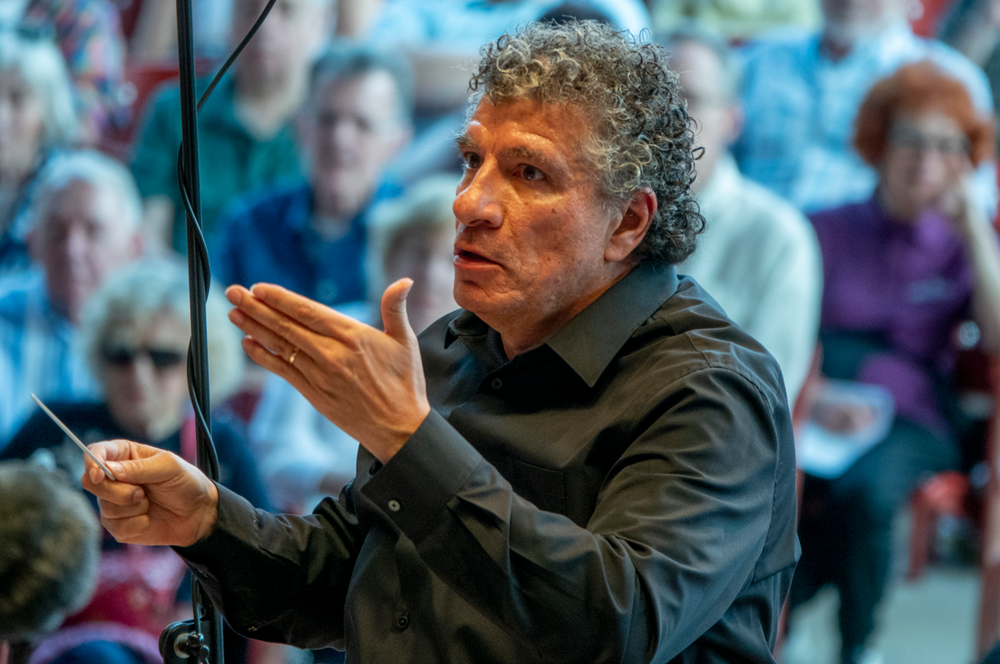
Bernstein West Side Story
Program
Joan Tower Made in America (13 mins)
Leonard Bernstein Symphonic Dances, from West Side Story (24 mins)
Prologue
"Somewhere"
Scherzo
Mambo
Cha Cha
Meeting Scene
"Cool" Fugue
Rumble
Finale
Samuel Barber Symphony No. 1 in One Movement (21 mins)
Allegro ma non troppo
Allegro molto
Andante tranquillo
Con moto (Passacaille)
Featuring
Program Notes
Joan Tower (b. 1938)
Made in America (2004)
Scored for: two flutes including piccolo, two oboes, two clarinets, two bassoons, two French horns, two trumpets, trombone, timpani, percussion, and strings
Performance time: 13 minutes
First Grant Park Orchestra performance.
Joan Tower spent much of her childhood in La Paz, Bolivia, after her family relocated there from New Rochelle, New York, when she was nine. She enjoyed the vibrant culture, particularly the saints’ festivals full of music and dance, but she recognized the poverty and lack of upward mobility faced by much of the local Incan population. When she returned to the United States for university, she gained a new-found appreciation for the basic luxuries and freedoms Americans enjoy, including the freedom to become a composer.
In 2004, Tower was commissioned to compose a new work by the Ford Made in America Consortium, a collective of 65 small American orchestras spearheaded by the League of American Orchestras and Meet The Composer. Because the resulting work would be played in all 50 states, she had to write something with broad appeal. So, she turned to the unofficial national anthem of the United States, “America the Beautiful,” for the work’s main theme. Rather than forming the basis of a set of variations, the song serves as a thread of hope and optimism, which Tower weaves throughout the piece.
“The beauty of the song is undeniable and I loved working with it as a musical idea,” Tower writes in her program note. However, the piece is far from jingoistic, instead celebrating America in all its complexity. She continues, “This theme is challenged by other more aggressive and dissonant ideas that keep interrupting, unsettling it, but ‘America the Beautiful’ keeps resurfacing in different guises (some small and tender, others big and magnanimous), as if to say, ‘I’m still here, ever changing, but holding my own.’ A musical struggle is heard throughout the work. Perhaps it was my unconscious reacting to the challenge of how do we keep America beautiful.”
—Katherine Buzard
Leonard Bernstein (1918-1990)
Symphonic Dances from West Side Story (1957)
Scored for: three flutes including piccolo, three oboes including English Horn, four clarinets including bass clarinet, three bassoons including contrabassoon, four French horns, three trumpets, three trombones, tuba, timpani, percussion, harp, celesta, piano, alto saxophone, and strings
Performance time: 24 minutes
First Grant Park Orchestra performance: Jul 11, 1964; Louis Lane, conductor
Although Leonard Bernstein was born and raised in Massachusetts, he is most associated with the city of New York given his longstanding relationship with the New York Philharmonic and highly popular Young People’s Concerts. It was there in that beautifully cacophonous clash of cultures that Bernstein was inspired to write his musical masterpiece, West Side Story.
Conceived by choreographer Jerome Robbins, with lyrics by Stephen Sondheim and a book by Arthur Laurents, West Side Story was a landmark achievement in American theater when it opened on Broadway in 1957. In the musical’s iconic score, Bernstein uses an eclectic mix of musical traditions, including Tin Pan Alley songs, jazz, and Latin dance forms, to represent the warring Sharks and Jets. The show was a hit, seeing a Broadway run of almost two years and 772 performances, plus a national tour. In 1960, the busy composer enlisted the help of Sid Ramin and Irwin Kostal, who had orchestrated the original Broadway production and would reorchestrate the score for the film, to extract nine sections from the score to create Symphonic Dances from West Side Story. The New York Philharmonic premiered the Symphonic Dances at a gala concert titled “Valentine for Leonard Bernstein” on February 13, 1961.
Jack Gottlieb, Bernstein’s longtime assistant, outlines how each section relates to the plot of the musical:
Prologue: The growing rivalry between two teenage gangs, the Jets and Sharks.
“Somewhere”: In a visionary dance sequence, the two gangs are united in friendship.
Scherzo: In the same dream, they break through the city walls, and suddenly find themselves in a world of space, air, and sun.
Mambo: Reality again; competitive dance between the gangs.
Cha-Cha: The star-crossed lovers see each other for the first time and dance together.
Meeting Scene: Music accompanies their first spoken words.
“Cool” Fugue: An elaborate dance sequence in which the Jets practice controlling their hostility.
Rumble: Climactic gang battle during which the two gang leaders are killed.
Finale: Love music developing into a processional, which recalls, in tragic reality, the vision of “Somewhere.”
—Katherine Buzard
Samuel Barber (1910-1981)
Symphony No. 1 in One Movement (1935)
Scored for: three flutes including piccolo, three oboes including English Horn, three clarinets including bass clarinet, three bassoons including contrabassoon, four French horns, three trumpets, three trombones, tuba, timpani, percussion, harp, and strings
Performance time: 21 minutes
First Grant Park Orchestra performance: Aug 21, 1964; Donald Johanos, conductor
Samuel Barber was one of the first students to enroll at the Curtis Institute in Philadelphia when it opened in 1924. Then only 14 years old, the precocious musician had started composing at age seven, penning his first operetta by age 10. He studied piano, voice, and composition at Curtis for 10 years. Shortly after graduating, he earned the coveted Prix de Rome in May 1935. This award came with a two-year residency at the American Academy in Rome. He spent the summer before he left for Italy in Camden, Maine, with fellow composer and romantic partner Gian Carlo Menotti. Each had their own projects, Menotti working on his opera Amelia Goes to the Ball and Barber setting out on what he called “an orchestra piece of ambitious tendencies.”
While in Rome, Barber made frequent excursions to other parts of Europe. His first trip was to the Anabel Taylor Foundation in Roquebrune-Cap-Martin on the French Riviera. Though the Foundation was an independent entity, it had an association with the American Academy and would often host the Academy’s musicians. It was during Barber’s stay from February 15 to March 1, 1936, that he completed his Symphony No. 1 (also titled Symphony in One Movement). The piece was Barber’s first international hit. After the premiere in Rome on December 13, 1936, it was performed by the Cleveland Orchestra, New York Philharmonic, London Symphony Orchestra, and Vienna Philharmonic the following year. The Vienna Philharmonic’s performance at the Salzburg Festival marked the first time an American symphonic work had been performed at the prestigious festival held in the city of Mozart’s birth.
In Symphony No. 1, Barber synthesizes the four movements of a traditional symphony into one continuous movement. Because of its compact structure, Barber presents the symphony’s main melodic ingredients in the first three minutes. The soaring first theme, introduced by the unison strings, begins with a majestic octave leap, followed by soulful descending intervals in dotted rhythms. Next, a more lyrical secondary theme is introduced by the English horn and violas. Finally, the unison upper winds and strings present a more declamatory closing theme after a trumpet crescendo and timpani roll. These three themes—which are continually developed, transformed, and reconfigured—serve as the symphony’s connective thread. For instance, the first theme appears in diminution (meaning the notes are broken up into shorter note values) to form the basis of the scherzo. In the finale, this theme recurs in the lower strings as a kind of repetitive baroque bassline called a passacaglia. Over this bassline, Barber weaves figures from all three motives, effectively recapping the entire symphony.
—Katherine Buzard
Event Sponsors
This concert is generously supported by the Mazza Foundation and American Accents Series Sponsor AbelsonTaylor Group.

Artistic Leadership
Support The Festival
Grant Park Orchestra
* denotes leave-of-absence † one-year position
Jeremy Black, concertmaster
Dima Dimitrova, acting assistant concertmaster
Trista Wong
Zulfiya Bashirova
Jennifer Cappelli
Injoo Choi
Erica Hudson
Hyewon Kim
Matthew Lehmann
Jayna Park
Rika Seko
Karen Sinclair
Bonnie Terry*
Krzysztof Zimowski
Liba Shacht, principal
Likai He, acting assistant principal
Ying Chai
Karl Davies
Ann Lehmann
Laura Miller
Cristina Muresan
Kjersti Nostbakken
Irene Radetzky
Jeanine Wynton
Thomas Yang
Bing Jing Yu†
Terri Van Valkinburgh, principal
Yoshihiko Nakano, assistant principal
Elizabeth Breslin
Beatrice Chen
Georgi Dimitrov
Amy Hess
Rebecca Swan
Chloé Thominet
Walter Haman, principal
Peter Szczepanek, assistant principal
Calum Cook
Larry Glazier
Steven Houser
Eric Kutz*
Eran Meir
Shinae Ra
Colin Corner, principal
Peter Hatch, assistant principal
Andrew Anderson
Christian Luevano
Samuel Rocklin
Chunyang Wang
Chris White
Elvin Schlanger, principal
Alyce Johnson
Jennifer Lawson, assistant principal
Jennifer Lawson
Mitchell Kuhn, principal
Gwendolyn Goble
Anne Bach, assistant principal
Anne Bach
Dario Brignoli, principal
Trevor O’Riordan, assistant principal
Besnik Abrashi
Besnik Abrashi
Eric Hall, principal
Nicole Haywood Vera Tenorio, assistant principal
Matthew Melillo
Matthew Melillo
Patrick Walle, acting principal†
Stephanie Blaha, assistant principal
Neil Kimel
Brett Hodge
Paul Clifton
David Gordon, principal
Mike Brozick
Rebecca Oliverio, assistant principal
Jeremy Moeller, acting principal
Lee Rogers, acting assistant principal†
Alexander Mullins
Andrew Smith, principal
Daniel Karas, principal
Josh Jones, principal
Sean Edwards, acting assistant principal†
Doug Waddell
Lynn Williams, acting principal†
Christopher Guzman
Eliza Bangert, principal
Carlos Chacón, violin
Valentina Guillen Menesello, violin
Steven Baloue, viola
Miquel Fuentes, cello