
Haydn Military Symphony
Program
Julia Perry Short Piece for Orchestra (7 mins)
Dmitri Shostakovich Concerto No. 1 in E-flat Major for Violoncello & Orchestra, op. 107 (30 mins)
Allegretto
Moderato
Cadenza
Allegro con moto
Franz Joseph Haydn Symphony No. 100 in G Major, Military (24 mins)
Adagio - Allegro
Allegretto
Menuet: Moderato
Presto
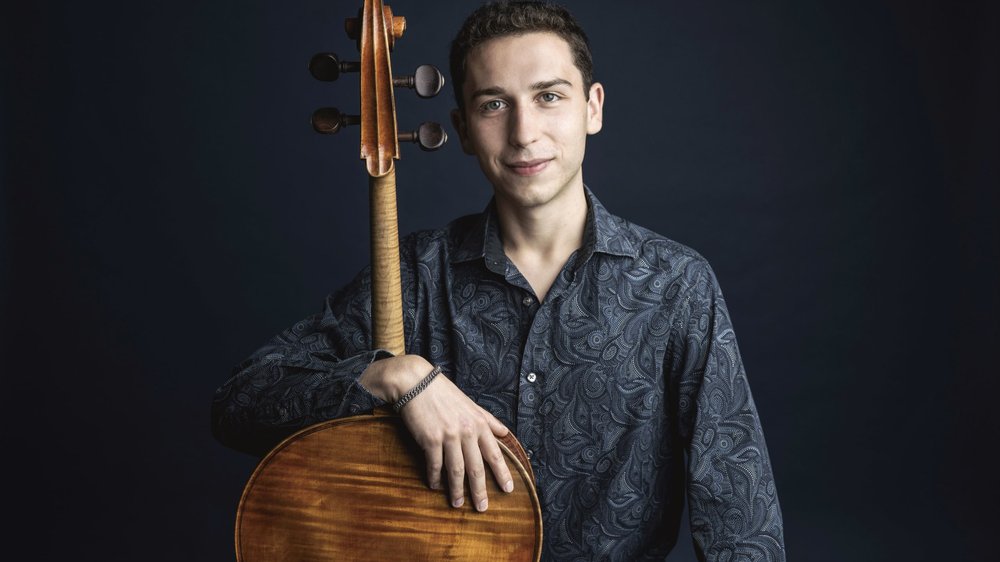
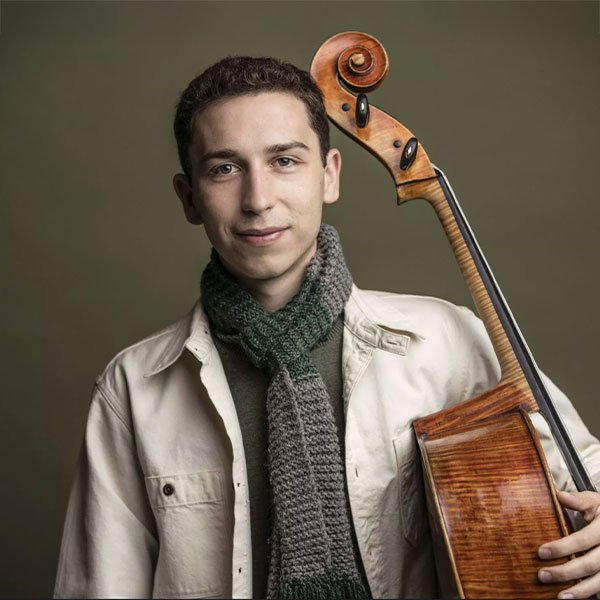
Featuring
Program Notes
Julia Perry (1924-1979)
Short Piece for Orchestra (1952)
Scored for: two flutes, two oboes, two clarinets, two bassoons, two French horns, two trumpets, two trombones, timpani, percussion, harp, piano, celesta, and strings
Performance time: 7 minutes
First Grant Park Orchestra performance: Jul 7, 2021; Carlos Kalmar, conductor
Julia Perry was born in 1924 to an upper-middle-class African American family who encouraged her musical ambitions. She spent most of her childhood in Akron, Ohio, where she studied violin, voice, and piano. After earning her bachelor’s and master’s degrees from Westminster Choir College, she took courses at Juilliard, Curtis, and Tanglewood. Her breakout piece, Stabat mater (1951), earned her two Guggenheim fellowships, which enabled her to travel to Europe in the early 1950s for further study.
She composed A Short Piece for Orchestra (also known as Study for Orchestra) in 1952 while studying with modernist composer Luigi Dallapiccola in Florence, Italy. While in Europe, her compositional style became more abstract and dissonant. As such, A Short Piece is marked by striking contrasts, rhythmic complexity, and the development of small motivic cells. The piece vacillates between the aggressive angularity of the opening figure and more meditative, haunting sections, first heard in the solo flute. A Short Piece made history in 1965 when it became the first piece by a woman of color to be performed and recorded live by the New York Philharmonic.
Despite her success in Europe, numerous awards, and favorable reviews, Perry struggled to break through in the predominantly white (and predominantly male) classical music world. Her career was further stymied by a series of strokes in the early 1970s, which left her paralyzed on her right side. She taught herself how to write with her left hand so she could continue to compose, but she never recaptured her earlier success. Tragically, she died in obscurity in 1979 at the age of 55. She left behind numerous large-scale orchestral works, including a dozen symphonies, two piano concertos, three operas, and a ballet. Although she is still relatively unknown today, recent efforts by musicologists and performers to recover her compositions have begun to restore her legacy.
—Katherine Buzard
Dmitri Shostakovich (1906-1975)
Concerto No. 1 in E-flat major for Violoncello & Orchestra, op. 107 (1959)
Scored for: two flutes including piccolo, two oboes, two clarinets, two bassoons including contrabassoon, French horn, timpani, celesta, solo cello, and strings
Performance time: 30 minutes
First Grant Park Orchestra performance: Aug 13, 1980; Otto-Werner Mueller, conductor; Yuli Turovsky, cello
“If you want Dmitri Dmitrievich to write something for you, the only recipe I can give you is this—never ask him or talk to him about it.” This is the advice Shostakovich’s wife, Nina Vasilyevna, gave cellist Mstislav Rostropovich when he asked how he could persuade her husband to write him a concerto. Shostakovich and Rostropovich were good friends, having met in 1943 when the 16-year-old cellist was a student in Shostakovich’s composition class at the Moscow Conservatory. Rostropovich’s patience paid off, and in the summer of 1959, Shostakovich wrote to him saying he’d composed a cello concerto. Rostropovich hightailed it to the composer’s dacha outside of Leningrad so that Shostakovich could play it for him on the piano. Just four days after this meeting, Rostropovich had not only learned the concerto but committed it to memory. He premiered the work two months later with Yevgeny Mravinsky and the Leningrad Philharmonic.
Shostakovich’s Cello Concerto No. 1 begins with a relentlessly nervous Allegretto, which the composer likened to “a jocular march.” Straight away, the soloist introduces a four-note theme out of which the rest of the movement develops. Some scholars have noted that this motto resembles Shostakovich’s musical signature (D-S-C-H, or D-E♭-C-B), found in other works of the same period. The theme’s anxious, questioning quality is heightened by the galloping rhythmic figure that accompanies it. The solo French horn—the only brass instrument in the relatively small orchestra—is never far away, interacting with the cello soloist throughout.
The ensuing Moderato presents a broad, lamenting theme for the cello, accompanied by sorrowful, creeping eighth notes in the violins. The movement ends in a ghostly duet between the high harmonics of the cello and the tinkling sonority of the celesta. The Moderato leads directly into an extended solo cadenza, which Shostakovich lists as its own movement. The cadenza meditates on previous themes, including the opening four-note motto. Gaining speed, the cadenza hurtles into the finale, which sees a return to the paranoid energy of the Allegretto.
In the finale, Shostakovich subtly quotes the Georgian folksong “Suliko,” a supposed favorite of his former adversary, Joseph Stalin. Although artistic strictures had loosened in the six years since Stalin’s death, Shostakovich still had to tread lightly. So, he only uses a short fragment, which he transforms from sweet into maddening through obsessive repetition. (The veiled quote was apparently so subtle that even Rostropovich didn’t notice it until Shostakovich pointed it out.) As the finale nears the end, the four-note motto returns, before timpani strokes bring the work to a decisive finish.
—Katherine Buzard
Franz Joseph Haydn (1732-1809)
Symphony No. 100 in G major, Military (1793)
Scored for: two flutes, two oboes, two clarinets, two bassoons, two French horns, two trumpets, timpani, percussion, and strings
Performance time: 24 minutes
First Grant Park Orchestra performance: Jul 31, 1940; Hans Lange, conductor
When Prince Nikolaus Esterházy died and his heir, Anton, dissolved the court’s musical establishment in 1790, Joseph Haydn found himself essentially a free agent after serving nearly 30 years as Kapellmeister of Prince Esterházy’s court. This position hadn’t allowed him to travel much, yet his works had already found considerable popularity abroad, especially in London. Violinist and concert producer Johan Peter Salomon took advantage of Haydn’s newfound freedom and invited him to London with the promise of numerous commissions for Salomon’s concert series.
Haydn’s secluded life at Esterházy could scarcely prepare him for the barrage of visitors and social invitations that greeted him when he arrived in England on New Year’s Day, 1791. He wrote, “My arrival caused a great sensation . . . Everyone wants to know me.” He continued, “If I wanted, I could dine out every day; but first I must consider my health, and second my work. Except for the nobility, I admit no callers until 2 o’clock.” After two exciting and prosperous years, Haydn returned to Vienna to fulfill his remaining obligations to Prince Anton (and give a young composer named Ludwig van Beethoven a few lessons).
Haydn returned to London for another two seasons in 1794. During this time, he wrote the last six of his 12 “London” symphonies, considered the crowning glory of his symphonic output. With Symphony No. 100, he set out to surpass the wild success of his “Surprise” Symphony (No. 94) two years before. At this point, Haydn was well-acquainted with the tastes of his voracious London audience and thought a military-themed piece would go over well while the British were at war with France. He was right: at the premiere on March 31, 1794, the audience erupted into spontaneous applause and called for an encore of the second movement.
The second movement—from which the symphony eventually got its nickname, “Military”—depicts an advancing army and military battle. For the main theme, Haydn borrows a march-like melody from a concerto for lire (a kind of hurdy-gurdy) that he had written for the King of Naples in 1786. To this, he adds a bevy of so-called “Turkish” percussion (triangle, cymbals, and bass drum), as was fashionable at the time. The percussion, sounding merely exotic at first, becomes more menacing as the movement progresses. A trumpet fanfare, quoting an Austrian military bugle call, followed by a dramatic drum roll and fortissimo crash in a remote key, heralds in the coda.
While it may seem like a tame depiction of war by modern standards, it was a thrilling moment of musical drama for Haydn’s audience. The week after the premiere, the Morning Chronicle described the movement as follows: “It is the advancing to battle; and the march of men, the sounding of the charge, the thundering of the onset, the clash of arms, the groans of the wounded, and what may well be called the hellish roar of war increase to a climax of horrid sublimity!”
While the rest of the symphony is not intended to depict war, military elements do creep in. The slow introduction to the first movement starts gently but builds to a fortissimo accompanied by timpani, foreshadowing the military might to come. Similarly, the third movement, a courtly Minuet, begins innocently enough but grows more aggressive as military fanfares disrupt the trio section. In the finale, a searing Presto, the battery of “Turkish” percussion returns not as a harrowing force but as a mark of victory.
—Katherine Buzard
Artistic Leadership
Support The Festival
Grant Park Orchestra
* denotes leave-of-absence † one-year position
Jeremy Black, concertmaster
Dima Dimitrova, acting assistant concertmaster
Trista Wong
Zulfiya Bashirova
Jennifer Cappelli
Injoo Choi
Erica Hudson
Hyewon Kim
Matthew Lehmann
Jayna Park
Rika Seko
Karen Sinclair
Bonnie Terry*
Krzysztof Zimowski
Liba Shacht, principal
Likai He, acting assistant principal
Ying Chai
Karl Davies
Ann Lehmann
Laura Miller
Cristina Muresan
Kjersti Nostbakken
Irene Radetzky
Jeanine Wynton
Thomas Yang
Bing Jing Yu†
Terri Van Valkinburgh, principal
Yoshihiko Nakano, assistant principal
Elizabeth Breslin
Beatrice Chen
Georgi Dimitrov
Amy Hess
Rebecca Swan
Chloé Thominet
Walter Haman, principal
Peter Szczepanek, assistant principal
Calum Cook
Larry Glazier
Steven Houser
Eric Kutz*
Eran Meir
Shinae Ra
Colin Corner, principal
Peter Hatch, assistant principal
Andrew Anderson
Christian Luevano
Samuel Rocklin
Chunyang Wang
Chris White
Elvin Schlanger, principal
Alyce Johnson
Jennifer Lawson, assistant principal
Jennifer Lawson
Mitchell Kuhn, principal
Gwendolyn Goble
Anne Bach, assistant principal
Anne Bach
Dario Brignoli, principal
Trevor O’Riordan, assistant principal
Besnik Abrashi
Besnik Abrashi
Eric Hall, principal
Nicole Haywood Vera Tenorio, assistant principal
Matthew Melillo
Matthew Melillo
Patrick Walle, acting principal†
Stephanie Blaha, assistant principal
Neil Kimel
Brett Hodge
Paul Clifton
David Gordon, principal
Mike Brozick
Rebecca Oliverio, assistant principal
Jeremy Moeller, acting principal
Lee Rogers, acting assistant principal†
Alexander Mullins
Andrew Smith, principal
Daniel Karas, principal
Josh Jones, principal
Sean Edwards, acting assistant principal†
Doug Waddell
Lynn Williams, acting principal†
Christopher Guzman
Eliza Bangert, principal
Carlos Chacón, violin
Valentina Guillen Menesello, violin
Steven Baloue, viola
Miquel Fuentes, cello