
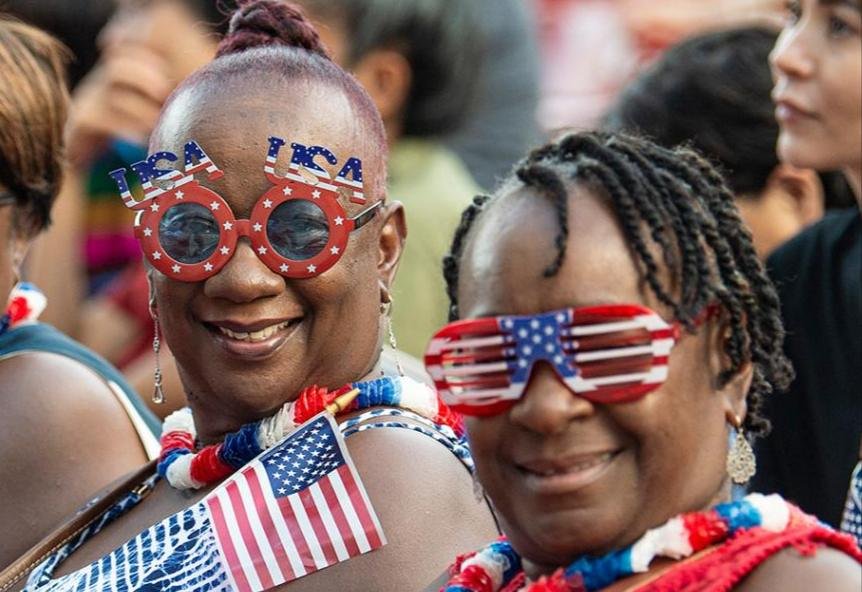
Independence Day Salute
Program
arr. Bob Krogstad Curtain Up! (7 mins)
Aaron Copland Fanfare for the Common Man (3 mins)
George Gershwin Three Preludes (7 mins)
James Horner / arr. John Moss Hollywood Blockbusters (7 mins)
Carlos Gardel / arr. John Williams Tango (Por una Cabeza) (3 mins)
Robert Wendel From Sea to Shining Sea (9 mins)
arr. Robert Lowden Armed Forces Salute (5 mins)
Jeff Tyzik Fantasy On American Themes (10 mins)
John Philip Sousa Stars and Stripes Forever (3 mins)
Featuring

Program Notes
Two hundred and fifty years ago today, the Second Continental Congress ratified the Declaration of Independence, asserting, “We hold these truths to be self-evident, that all men are created equal, that they are endowed by their Creator with certain unalienable Rights, that among these are Life, Liberty and the pursuit of Happiness.” The Great Park Music Festival is celebrating the anniversary of this momentous event with a season devoted to American classical music. Tonight, we’re going all out with a program of American favorites from Broadway, Hollywood, popular music, and more.
America’s musical heritage is as vibrant and diverse as its people. Whether explicitly patriotic or simply reflective of the American spirit, a wide variety of music has served as an expression of our national identity and values. One composer who has become synonymous with American classical music is Aaron Copland. For a city kid born in Brooklyn to Eastern European Jewish immigrant parents, Copland had a surprising knack for rendering rural America, particularly the West, in his music. Alongside works like Lincoln Portrait and his trio of “Americana” ballets (Billy the Kid, Rodeo, and Appalachian Spring), Fanfare for the Common Man helped solidify Copland’s reputation as the “Dean of American Composers.” With its brassy, open chords evoking vast landscapes, Fanfare for the Common Man became a template for composers seeking an “American” sound.
Fanfare for the Common Man was the result of a commission by conductor Eugene Goossens of the Cincinnati Symphony Orchestra. In 1942, he commissioned a series of patriotic fanfares to inspire national unity during World War II. Far from a jingoistic romp, Copland’s fanfare was inspired by a speech by then-Vice President Henry A. Wallace, who proclaimed the dawning of the “Century of the Common Man.” His speech was a counterargument to Life magazine publisher Henry Luce’s call for an “American century” in which America would dominate the post-war world.
Another seminal component of American music is the music of Broadway. Bob Krogstad’s Curtain Up! is a medley of six iconic songs from The Great White Way: “Don’t Rain On My Parade” from Funny Girl, “Everything’s Coming Up Roses” from Gypsy, “If He Walked Into My Life” from Mame, “One” from A Chorus Line, “The Phantom of the Opera” from The Phantom of the Opera, and “There’s No Business Like Show Business” from Annie Get Your Gun.
American musical theater wouldn’t be what it is today without George Gershwin. In the 1920s, Gershwin dominated Broadway with a series of musical comedy romps that captured the energy of the Roaring Twenties with their dance rhythms, jazzy harmonies, and vernacular language. He brought that theatrical pizzazz into the concert hall with Three Preludes, originally written for solo piano but arranged here by Rainer Schottstaedt for strings and solo clarinet. The first movement opens with a bluesy five-note motif, underpinned by a syncopated rhythm derived from Brazilian music. Gershwin called the second movement “a sort of blues lullaby,” while the third movement features two melodies that act as a call and response.
Hollywood was, of course, heavily influenced by musical theater. The advent of “talkies” in the late 1920s and early ’30s brought many Broadway composers to Tinseltown to try their hand at composing for motion pictures. Film scores then became another integral part of American music. In Hollywood Blockbusters, we hear highlights from James Horner’s film scores—Apollo 13, An American Tail, Braveheart, and Titanic—arranged by John Moss. Tango (Por Una Cabeza) comes from another famous movie moment: the tango scene from Scent of a Woman, directed by Martin Brest and starring Al Pacino. “Por Una Cabeza” was written in 1935 by Argentine singer-songwriter Carlos Gardel, the most famous interpreter of tango of the 20th century. John Williams arranged the tango for orchestra and violinist Itzhak Perlman in 2009.
Next, Robert Wendel’s From Sea to Shining Sea takes us on a musical journey across the United States in a medley of popular songs, including “America the Beautiful,” “San Francisco,” “Deep in the Heart of Texas,” “Meet Me in Saint Louis,” “The Tennessee Waltz,” “Chicago (That Toddlin’ Town),” “My Old Kentucky Home,” “Georgia On My Mind,” “Carolina in the Morning,” and “New York, New York.”
Jeff Tyzik’s Fantasy on American Themes also brings together a selection of American folk songs. “America the Beautiful” makes another appearance, alongside “When Johnny Comes Marching Home,” a popular Civil War-era song, and “Yankee Doodle,” the most enduring song from the American Revolution. According to traditional lore, the text of “Yankee Doodle” was penned in 1755 by a British army doctor named Richard Schuckburg. Originally intended to mock the “uncouth” American colonists who fought alongside British troops during the French and Indian War, the song was embraced by the very people it set out to ridicule. Americans adopted “Yankee Doodle” with pride, and it soon gained popularity on both sides during the Revolutionary War.
No concert of patriotic music would be complete without a tribute to those who have bravely served in the military. Robert Lowden’s Armed Forces Salute pays homage to five branches of the United States Armed Forces with “The Caisson Song,” “Semper Paratus,” “The Marines’ Hymn,” “The U.S. Air Force,” and “Anchors Aweigh.”
A military man himself, John Philip Sousa began his career as an apprentice in the United States Marine Band, eventually becoming its music director. On Christmas Day, 1896, memories of his time leading the band in official ceremonies moved him to write his most famous march, Stars and Stripes Forever: “I could see the Stars and Stripes flying from the flagstaff in the grounds of the White House just as plainly as if I were back there again. I began to think of all the countries I had visited . . . and that flag of ours became glorified.”
—Katherine Buzard
Event Sponsors
This concert is generously supported by American Accents Series Sponsor AbelsonTaylor Group. Special thanks to Nancy Meyerson and to the color guard from the Rickover Naval Academy, a Chicago public school.

Artistic Leadership
Support The Festival
Grant Park Orchestra
* denotes leave-of-absence † one-year position
Jeremy Black, concertmaster
Dima Dimitrova, acting assistant concertmaster
Trista Wong
Zulfiya Bashirova
Jennifer Cappelli
Injoo Choi
Erica Hudson
Hyewon Kim
Matthew Lehmann
Jayna Park
Rika Seko
Karen Sinclair
Bonnie Terry*
Krzysztof Zimowski
Liba Shacht, principal
Likai He, acting assistant principal
Ying Chai
Karl Davies
Ann Lehmann
Laura Miller
Cristina Muresan
Kjersti Nostbakken
Irene Radetzky
Jeanine Wynton
Thomas Yang
Bing Jing Yu†
Terri Van Valkinburgh, principal
Yoshihiko Nakano, assistant principal
Elizabeth Breslin
Beatrice Chen
Georgi Dimitrov
Amy Hess
Rebecca Swan
Chloé Thominet
Walter Haman, principal
Peter Szczepanek, assistant principal
Calum Cook
Larry Glazier
Steven Houser
Eric Kutz*
Eran Meir
Shinae Ra
Colin Corner, principal
Peter Hatch, assistant principal
Andrew Anderson
Christian Luevano
Samuel Rocklin
Chunyang Wang
Chris White
Elvin Schlanger, principal
Alyce Johnson
Jennifer Lawson, assistant principal
Jennifer Lawson
Mitchell Kuhn, principal
Gwendolyn Goble
Anne Bach, assistant principal
Anne Bach
Dario Brignoli, principal
Trevor O’Riordan, assistant principal
Besnik Abrashi
Besnik Abrashi
Eric Hall, principal
Nicole Haywood Vera Tenorio, assistant principal
Matthew Melillo
Matthew Melillo
Patrick Walle, acting principal†
Stephanie Blaha, assistant principal
Neil Kimel
Brett Hodge
Paul Clifton
David Gordon, principal
Mike Brozick
Rebecca Oliverio, assistant principal
Jeremy Moeller, acting principal
Lee Rogers, acting assistant principal†
Alexander Mullins
Andrew Smith, principal
Daniel Karas, principal
Josh Jones, principal
Sean Edwards, acting assistant principal†
Doug Waddell
Lynn Williams, acting principal†
Christopher Guzman
Eliza Bangert, principal
Carlos Chacón, violin
Valentina Guillen Menesello, violin
Steven Baloue, viola
Miquel Fuentes, cello