
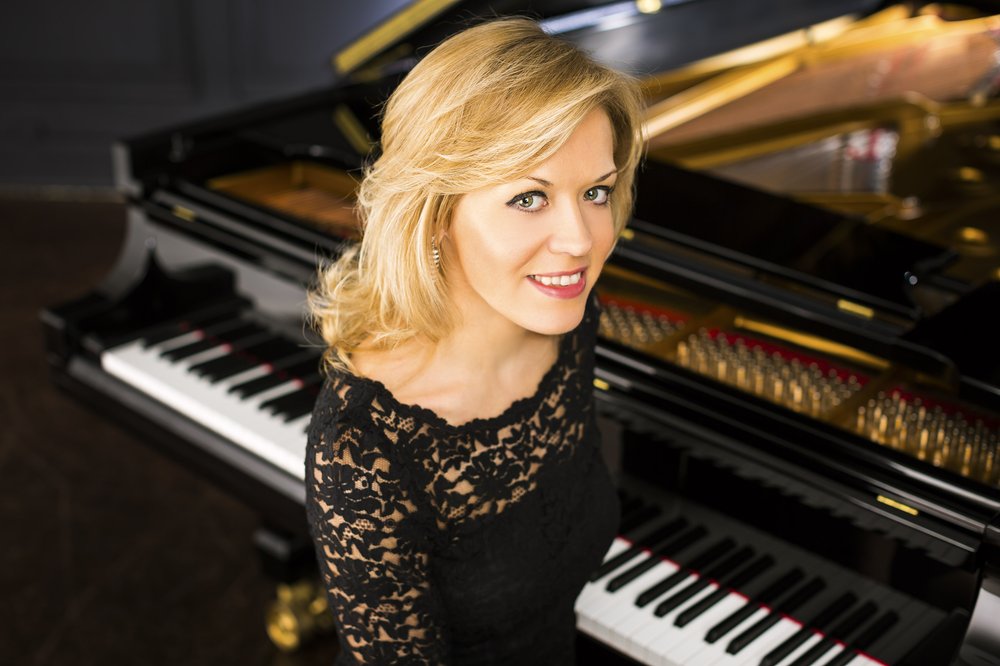
Rachmaninov Piano Concerto No. 3
Program
Sergei Rachmaninov Concerto No. 3 in D minor for Piano & Orchestra, op. 30 (39 mins)
Allegro ma non tanto
Intermezzo
Finale
Intermission (20 mins)
Igor Stravinsky Jeu de cartes (Game of Cards) (23 mins)
First Deal
Second Deal
Third Deal
Edward Elgar In the South (Alassio), op. 50 (20 mins)
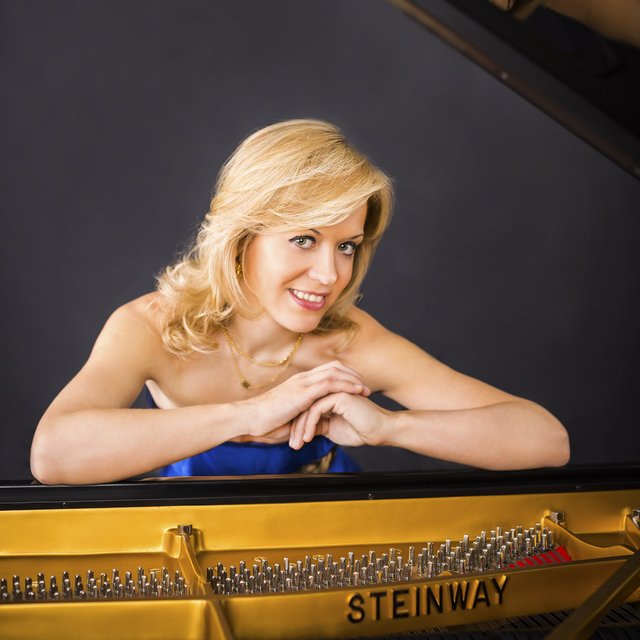
Featuring

Program Notes
Sergei Rachmaninov (1873-1943)
Concerto No. 3 in D minor for Piano & Orchestra, op. 30 (1909)
Scored for: two flutes, two oboes, two clarinets, two bassoons, four French horns, two trumpets, three trombones, tuba, timpani, percussion, solo piano, and strings
Performance time: 39 minutes
First Grant Park Orchestra performance: Jul 6, 1949; Nicolai Malko, conductor; Sigi Weissenberg, piano
Sergei Rachmaninov was reluctant to undertake an American concert tour, but financial pressures meant he couldn’t say no. In the summer of 1909, he composed a new piano concerto for the occasion. Having only just finished the score before embarking on the transatlantic voyage, he did not have time to get the concerto under his hands. So, he spent hours each day on the ship practicing on a dummy keyboard in his cabin. He premiered his Piano Concerto No. 3 with the New York Symphony under Walter Damrosch on November 28, 1909, and repeated it 19 days later with the New York Philharmonic under another European composer seeking his fortune in America, Gustav Mahler.
Rachmaninov’s Piano Concerto No. 3 received a relatively cold reception from the American public and press, despite audiences’ calls for numerous encores, particularly of his famous Prelude in C# Minor. European critics were more positive, though many considered it more a vehicle for Rachmaninov’s inimitable pianism than a noteworthy composition in its own right. In fact, the piano part was so technically challenging that the pianist to whom Rachmaninov dedicated the concerto, Josef Hoffmann, never played the work, owing to his relatively small hands.
It took two decades for the concerto to become cemented in the repertory. In January 1928, Rachmaninov invited pianist Vladimir Horowitz—then only 26 and about to make his US debut at Carnegie Hall—to run through the concerto. They met in the basement of Steinway’s New York showroom, with the composer playing the orchestral reduction on a second piano. Afterwards, Rachmaninov said the young pianist had “swallowed [the concerto] whole,” adding, “He had the courage, the intensity, and daring that make for greatness.” The work soon became Horowitz’s calling card, and he was the first to record it in 1930. Thanks to him, “Rach 3” is now considered the piece against which concert pianists test their mettle.
The concerto opens with quiet anticipation, the piano intoning a brooding melody over the rhythmic motor of gently pulsing strings. Scholars have noted the theme’s similarity to a Russian Orthodox chant. Rachmaninov denied this but acknowledged the melody’s vocal quality, saying, “If I had any plan in composing this theme, I was thinking only of sound. I wanted to ‘sing’ the melody on the piano, as a singer would sing it—and to find a suitable orchestral accompaniment, or rather one that would not muffle the singing.” After a brief piano cadenza, the second theme is introduced as a staccato march in dialogue between the piano and orchestra, before evolving into a sweet, lyrical melody. For the climax of the movement, Rachmaninov wrote two cadenza options. The first is longer and denser, characterized by massive chords, while the other, which Rachmaninov preferred to play himself, is lighter and more toccata-like.
The “Intermezzo” is cast as a theme and variations. The theme first appears in the oboe and clarinet during the extended orchestral introduction. Eventually, the piano enters, shutting down the orchestra with a dramatic cascading figure before offering a version of the theme in a distant key. Several variations are heard before a contrasting waltz section suddenly breaks through. Under the pianist’s fleet fingers, the clarinet and bassoon play a variation of the concerto’s opening melody. After a dramatic preparatory gesture, the finale gallops in without pause. The astonishing virtuosic displays of the finale belie the movement’s careful construction, as it references the themes of the previous movements. Perhaps if early critics had not been so dazzled by Rachmaninov’s virtuosity, they would have recognized the substance and attention to detail underpinning the whole concerto.
—Katherine Buzard
Igor Stravinsky (1882-1971)
Jeu de cartes (Game of Cards) (1936)
Scored for: two flutes including piccolo, two oboes including English Horn, two clarinets, two bassoons, four French horns, two trumpets, three trombones, tuba, timpani, percussion, and strings
Performance time: 23 minutes
First Grant Park Orchestra performance: Jul 15, 1970; Jorge Mester, conductor
What would you expect to find in a composer’s briefcase? An assortment of pencils, erasers, and a notepad, sure . . . but a deck of cards? According to Igor Stravinsky’s longtime assistant, Robert Craft, the Russian–American composer always had a deck of playing cards with him. Perhaps it was the contents of his bag that inspired the scenario for his 1937 ballet Jeu de Cartes (“A Game of Cards”). Stravinsky later recalled in an interview that he was in the back of a Parisian taxi cab when the idea came to him for a ballet “with playing-card costumes and a green-baize gaming-table backdrop.” He was so chuffed by the concept that he offered to buy the cabbie a drink.
While this anecdote may be apocryphal, Stravinsky held onto the idea for about a decade before he was finally able to use it. In 1935, he received a commission from Lincoln Kirstein and choreographer George Balanchine of the newly established School of American Ballet to compose a ballet for their company to perform at the Metropolitan Opera as part of the first-ever “Stravinsky Festival” in April 1937.
Subtitled “A Ballet in Three Deals,” Jeu de Cartes begins with an initial shuffle—a fanfare that recurs between each of the three rounds. “At each deal the situation is complicated by the endless guiles of the perfidious Joker, who believes himself invincible because of his ability to become any desired card,” Stravinsky explains. In the first deal, the hand with the Joker loses to one player and ties with another. In the second, the hand with the Joker is victorious when he turns himself into a fourth Ace to beat four Queens. In the third round, all three players have flushes, but the Joker is beaten by a Royal Flush in Hearts. “This puts an end to his malice and knavery,” Stravinsky concludes.
Jeu de Cartes exemplifies Stravinsky’s “neoclassical” period (c. 1920–1950) in its largely tonal harmonic language, transparent orchestral textures, more regular rhythms and meters, and emphasis on balance and order over Romantic emotionality. Musical quotations of composers such as Beethoven, Ravel, Delibes, and Johann Strauss add to the historical feel. Yet, none of these references are overt, aside from an immediately recognizable allusion to Rossini’s Barber of Seville in the “Battle Between Spades and Hearts” in the third deal. Stravinsky deploys these musical scraps for comedic effect, as if he himself is the Joker, laying musical Easter eggs for the keen-eared to find.
—Katherine Buzard
Edward Elgar (1857-1934)
In the South (Alassio), op. 50 (1903)
Scored for: three flutes including piccolo, three oboes including English Horn, three clarinets including bass clarinet, three bassoons including contrabassoon, four French horns, three trumpets, three trombones, tuba, timpani, percussion, harp, and strings
Performance time: 20 minutes
First Grant Park Orchestra performance: Aug 11, 1993; Michael Morgan, conductor
Edward Elgar was just one in a long line of composers who found musical inspiration in Italy, a land so full of music, “you only have to take as much of it as you need,” he said. In 1903, overwhelmed by his sudden popularity and the weight of public expectations following the success of his Enigma Variations, Elgar and his wife left England to winter in the Italian coastal town of Alassio. A three-day festival devoted exclusively to Elgar’s music was planned at the Royal Opera House in London the following spring, where it was expected he would premiere his first symphony—a grand work that would do his country proud. It took a few more years before that symphony became a reality, but while walking in the Italian countryside, Elgar had a stroke of inspiration for something different: “I was by the side of an old Roman way,” he wrote. “A peasant shepherd stood by an old ruin, and in a flash, it all came to me—the conflict of armies in that very spot long ago, where now I stood—the contrast of the ruin and the shepherd . . . At that time, I had ‘composed’ the overture—the rest was merely writing it down.”
Although Elgar calls In the South (Alassio) a “concert overture,” it might be better described as a “tone poem” akin to those by Richard Strauss (who was himself inspired by Italy in one of his most famous tone poems, Aus Italien). Not only does the exuberant opening of In the South recall that of Strauss’s Don Juan, but the colorful orchestration is also indebted to the German composer. Elgar labels this vibrant opening theme “Joy of living (wine and macaroni),” capturing “the exhilarating out-of-doors feeling arising from the gloriously beautiful surroundings—streams, flowers, hills and distant snowy mountains in one direction and the blue Mediterranean in the other.” A pastoral episode follows, with the clarinet playing the role of the shepherd among the ruins. Next, the “relentless and domineering onward force” of the armies of ancient Rome march past, before the solo viola intones a nocturnal serenade reminiscent of a Neapolitan popular song over an accompaniment of harp and hushed strings. The song is cut off by a restatement of the energetic opening figure, leading into the richly scored coda.
—Katherine Buzard
Event Sponsors
This concert is generously sponsored by Jeannette and Jerry Goldstone.
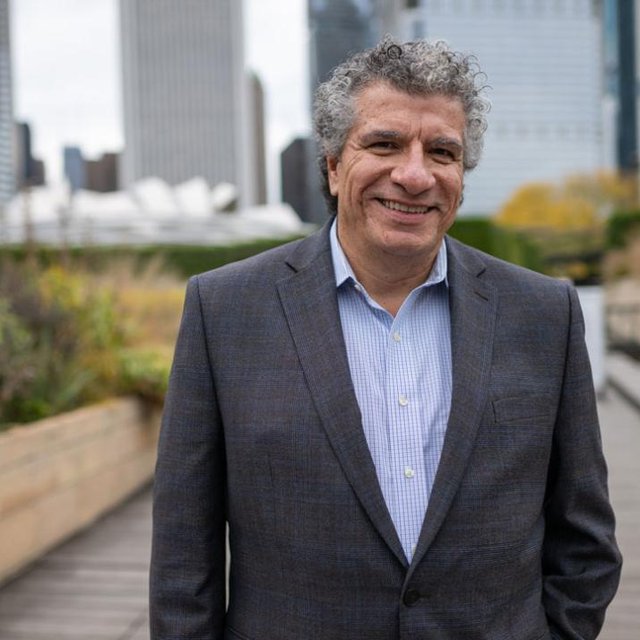
Artistic Leadership
Support The Festival
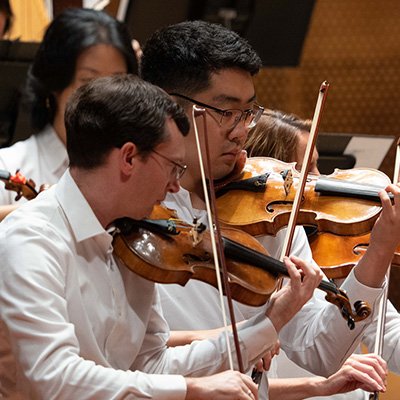
Grant Park Orchestra
* denotes leave-of-absence † one-year position
Jeremy Black, concertmaster
Dima Dimitrova, acting assistant concertmaster
Trista Wong
Zulfiya Bashirova
Jennifer Cappelli
Injoo Choi
Erica Hudson
Hyewon Kim
Matthew Lehmann
Jayna Park
Rika Seko
Karen Sinclair
Bonnie Terry*
Krzysztof Zimowski
Liba Shacht, principal
Likai He, acting assistant principal
Ying Chai
Karl Davies
Ann Lehmann
Laura Miller
Cristina Muresan
Kjersti Nostbakken
Irene Radetzky
Jeanine Wynton
Thomas Yang
Bing Jing Yu†
Terri Van Valkinburgh, principal
Yoshihiko Nakano, assistant principal
Elizabeth Breslin
Beatrice Chen
Georgi Dimitrov
Amy Hess
Rebecca Swan
Chloé Thominet
Walter Haman, principal
Peter Szczepanek, assistant principal
Calum Cook
Larry Glazier
Steven Houser
Eric Kutz*
Eran Meir
Shinae Ra
Colin Corner, principal
Peter Hatch, assistant principal
Andrew Anderson
Christian Luevano
Samuel Rocklin
Chunyang Wang
Chris White
Elvin Schlanger, principal
Alyce Johnson
Jennifer Lawson, assistant principal
Jennifer Lawson
Mitchell Kuhn, principal
Gwendolyn Goble
Anne Bach, assistant principal
Anne Bach
Dario Brignoli, principal
Trevor O’Riordan, assistant principal
Besnik Abrashi
Besnik Abrashi
Eric Hall, principal
Nicole Haywood Vera Tenorio, assistant principal
Matthew Melillo
Matthew Melillo
Patrick Walle, acting principal†
Stephanie Blaha, assistant principal
Neil Kimel
Brett Hodge
Paul Clifton
David Gordon, principal
Mike Brozick
Rebecca Oliverio, assistant principal
Jeremy Moeller, acting principal
Lee Rogers, acting assistant principal†
Alexander Mullins
Andrew Smith, principal
Daniel Karas, principal
Josh Jones, principal
Sean Edwards, acting assistant principal†
Doug Waddell
Lynn Williams, acting principal†
Christopher Guzman
Eliza Bangert, principal
Carlos Chacón, violin
Valentina Guillen Menesello, violin
Steven Baloue, viola
Miquel Fuentes, cello