
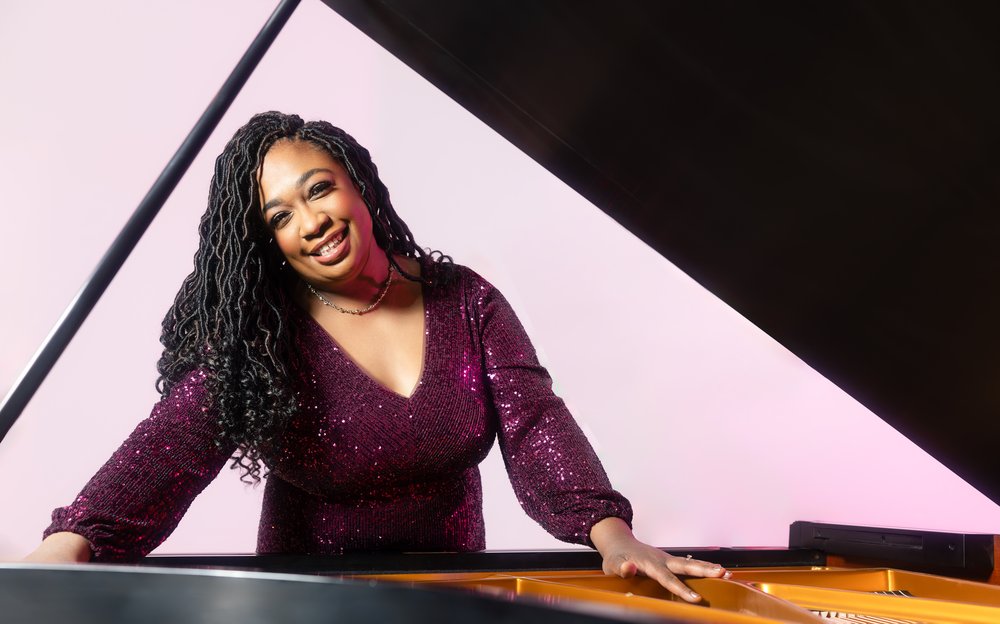
Ravel Piano Concerto
Program
William Grant Still Festive Overture (10 mins)
Maurice Ravel Concerto in G major for Piano & Orchestra (23 mins)
Allegramente
Adagio assai
Presto
Florence Price Symphony No.3 in C minor (30 mins)
Andante; Allegro
Andante ma non troppo
Juba: Allegro
Scherzo. Finale
Featuring
Program Notes
William Grant Still (1895-1978)
Festive Overture (1944)
Scored for: three flutes including piccolo, three oboes including English Horn, three clarinets including bass clarinet, two bassoons, four French horns, three trumpets, three trombones, tuba, timpani, percussion, harp, celesta, and strings
Performance time: 10 minutes
First Grant Park Orchestra performance: Jul 13, 1946; Izler Solomon, conductor
Often referred to as the “Dean of African American Composers,” William Grant Still was a renowned composer and arranger, with numerous commissions from prominent symphony orchestras and conductors to his name. Throughout his prolific career in both commercial and art music, he broke numerous racial barriers, accumulating several “firsts”: the first African American composer to have a symphony performed by a major orchestra (Rochester Symphony, 1931), to conduct a major orchestra (Los Angeles Philharmonic, 1936), and to have an opera performed by a top-tier company (New York City Opera, 1949), to name a few. He is credited with pioneering a nationalistic American style of concert music based on African American folk and vernacular music idioms.
In December 1944, Still won the Cincinnati Symphony Orchestra’s Jubilee Prize, along with a $1,000 war bond, for his Festive Overture. In honor of the orchestra’s 50th anniversary, then-Music Director Eugene Goossens had mounted a nationwide search for “Best Overture.” Still’s offering was selected unanimously by the judges from a pool of 39 anonymized submissions. The Cincinnati Symphony Orchestra premiered Still’s Festive Overture one month later. In the program note, Goossens cited the overture’s “definite American flavor,” which “bespeaks the pride of the composer in his native land, the warmth of the American people, and the grandeur of Scenic America.”
—Katherine Buzard
Maurice Ravel (1875-1937)
Concerto in G major for Piano & Orchestra (1929)
Scored for: two flutes including piccolo, two oboes including English Horn, two clarinets including bass clarinet, two bassoons, two French horns, trumpet, trombone, timpani, percussion, harp, solo piano, and strings
Performance time: 23 minutes
First Grant Park Orchestra performance: Jul 10, 1957; Theodore Bloomfield, conductor and Istvan Nadas, piano
In 1928, Maurice Ravel undertook a grueling but successful four-month tour of North America. Although he disliked American food and the Midwest’s subzero temperatures, meeting George Gershwin made the trip worthwhile. They first met at Ravel’s 53rd birthday party in New York, then spent several nights hopping between Harlem jazz clubs. Jazz had already made its way to Paris by the late 1920s, but Gershwin deepened Ravel’s appreciation, inspiring him to incorporate more jazz elements into his subsequent compositions.
Ravel began composing Piano Concerto in G in 1929, but a commission from Paul Wittgenstein, an Austrian pianist who had lost his right arm in World War I, delayed it. He returned to the G-Major concerto after completing his Piano Concerto for the Left Hand for Wittgenstein in 1930. He intended to premiere the Piano Concerto in G himself, but by the time he completed it in November 1931, his health had deteriorated due to an undiagnosed neurodegenerative condition. “The concerto is nearly finished, and I am not far from being so myself,” he wrote. No longer able to perform the piece to his standards, he enlisted the help of his former student Marguerite Long, who had premiered his piano suite Le tombeau de Couperin in 1919. He conducted the premiere in Paris with Long at the piano in January 1932. The pair soon embarked on an extensive European tour, culminating in a recording of the concerto for Columbia Records.
A crack of the slapstick sets the Piano Concerto in G in motion. Syncopated pizzicato strings and tinkling piano pulse underneath a jaunty piccolo melody. Frequent syncopation, saucy blue notes, and trombone smears all proclaim the influence of jazz, which Ravel mixes with flavors of his native Basque country. The Adagio, as music critic Michael Steinberg puts it, “is the reason we not only delight in this concerto but truly love it.” Although it sounds sublimely effortless, Ravel toiled over its composition, writing only two bars at a time. The piano breathes a long, expressive phrase over a simple waltzing accompaniment in the left hand. After a gentle trill, the orchestra finally enters with a surprising cadence and gently soaring woodwinds. The English horn eventually takes up the main melody, which the piano decorates with pearls of cascading figures. A long trill closes out the Adagio, ushering in a showstopping finale that recalls the energy of the first movement, with car horns, chromatic sighs, and a clarinet shriek adding jazzy color to the moto perpetuo.
—Katherine Buzard
Florence Price (1887-1953)
Symphony No.3 in C minor (1940)
Scored for: four flutes including piccolo, three oboes including English Horn, three clarinets including bass clarinet, two bassoons, four French horns, three trumpets, three trombones, tuba, timpani, percussion, harp, celesta, and strings
Performance time: 30 minutes
First Grant Park Orchestra performance.
“I spent two of the pleasantest hours I have ever spent visiting music projects yesterday morning in Detroit,” First Lady Eleanor Roosevelt recounted in her syndicated column My Day on November 14, 1940. “[The orchestra] played two movements in a new symphony by Florence Price, one of the few women to write symphonic music. She is a colored woman and a native of Chicago, who has certainly made a contribution to our music. The orchestra rendered her symphony beautifully.” Despite this high-profile praise, Florence Price’s Symphony No. 3 in C Minor was not performed again in the composer’s lifetime after its premiere by the Michigan WPA Symphony Orchestra in November 1940. It languished unperformed until 2001 and remained unpublished until 2008.
The symphony’s fall into obscurity was not for lack of trying. Price repeatedly reached out to conductors such as Artur Rodziński and Serge Koussevitzky, imploring them to look past what she called her “two handicaps—those of sex and race” and program her work. The radio silence she got in return was especially frustrating given that she was not some upstart composer but had won numerous awards and achieved national acclaim. Notably, her Symphony No. 1 in E minor was premiered by the Chicago Symphony Orchestra in 1933, making Price the first African American woman composer to have a symphony played by a major orchestra. (Even with that auspicious start, her First Symphony also remained unpublished until 2008.)
Price’s Third Symphony was the result of a commission by the Works Progress Administration’s (WPA) Federal Music Project, a New Deal initiative to support musicians during the Great Depression. The symphony signaled a new stage in Price’s compositional development, marking a departure from her First Symphony in its maturity and sophistication. “It is intended to be Negroid in character and expression, a cross-section of present-day Negro life and thought with its heritage of that which is past, paralleled or influenced by concepts of the present day,” Price explained in a letter to conductor Frederick Schwass in 1943. “No attempt, however, has been made to project Negro music solely in the purely traditional manner.” In other words, she attempts to capture aspects of her musical heritage without directly quoting folk songs or dances and mixes these influences with elements of modernism within a symphonic framework.
The first movement unfolds mysteriously with a slow brass introduction reminiscent of Wagner. Throughout the movement, a darkly turbulent main theme is pitted against a lush, spiritual-like melody, introduced by the solo trombone. The Andante begins in a state of utter tranquility. A melancholy theme in the bassoon, answered by ominous timpani rolls and a whole tone gesture in the winds, destabilizes the otherwise peaceful atmosphere. By contrast, the joyful third movement evokes the syncopated rhythms of the juba, with a slinking habanera in the middle. Ending forcefully, the finale is a swashbuckling Scherzo full of dissonance, chromaticism, and percussive outbursts.
—Katherine Buzard
Event Sponsors
This concert is generously sponsored as part of the Hanson Community Connection Series.
Lead support for this program is graciously provided by the Robert and Isabelle Bass Foundation, Inc.
Artistic Leadership
Support The Festival
Grant Park Orchestra
* denotes leave-of-absence † one-year position
Jeremy Black, concertmaster
Dima Dimitrova, acting assistant concertmaster
Trista Wong
Zulfiya Bashirova
Jennifer Cappelli
Injoo Choi
Erica Hudson
Hyewon Kim
Matthew Lehmann
Jayna Park
Rika Seko
Karen Sinclair
Bonnie Terry*
Krzysztof Zimowski
Liba Shacht, principal
Likai He, acting assistant principal
Ying Chai
Karl Davies
Ann Lehmann
Laura Miller
Cristina Muresan
Kjersti Nostbakken
Irene Radetzky
Jeanine Wynton
Thomas Yang
Bing Jing Yu†
Terri Van Valkinburgh, principal
Yoshihiko Nakano, assistant principal
Elizabeth Breslin
Beatrice Chen
Georgi Dimitrov
Amy Hess
Rebecca Swan
Chloé Thominet
Walter Haman, principal
Peter Szczepanek, assistant principal
Calum Cook
Larry Glazier
Steven Houser
Eric Kutz*
Eran Meir
Shinae Ra
Colin Corner, principal
Peter Hatch, assistant principal
Andrew Anderson
Christian Luevano
Samuel Rocklin
Chunyang Wang
Chris White
Elvin Schlanger, principal
Alyce Johnson
Jennifer Lawson, assistant principal
Jennifer Lawson
Mitchell Kuhn, principal
Gwendolyn Goble
Anne Bach, assistant principal
Anne Bach
Dario Brignoli, principal
Trevor O’Riordan, assistant principal
Besnik Abrashi
Besnik Abrashi
Eric Hall, principal
Nicole Haywood Vera Tenorio, assistant principal
Matthew Melillo
Matthew Melillo
Patrick Walle, acting principal†
Stephanie Blaha, assistant principal
Neil Kimel
Brett Hodge
Paul Clifton
David Gordon, principal
Mike Brozick
Rebecca Oliverio, assistant principal
Jeremy Moeller, acting principal
Lee Rogers, acting assistant principal†
Alexander Mullins
Andrew Smith, principal
Daniel Karas, principal
Josh Jones, principal
Sean Edwards, acting assistant principal†
Doug Waddell
Lynn Williams, acting principal†
Christopher Guzman
Eliza Bangert, principal
Carlos Chacón, violin
Valentina Guillen Menesello, violin
Steven Baloue, viola
Miquel Fuentes, cello