
Sibelius Symphony No. 2
Program
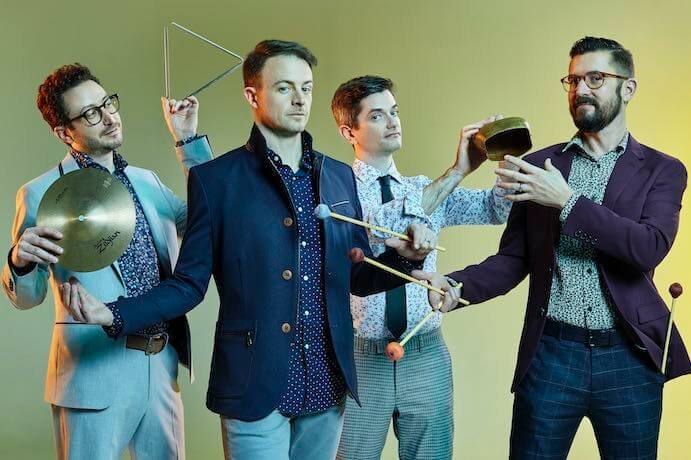
Christopher Theofanidis Drum Circles (25 mins)
Rivers and Anthems
Sparks and Chants
How Can You Smile When You’re Deep in Thought?
Spirits and Drums
Three Chords and the Truth (or, Learning to Breathe Again)
Jean Sibelius Symphony No. 2 in D major, op. 43 (43 mins)
Allegretto
Andante; ma rubato
Vivacissimo
Finale: Allegro moderato
Featuring

Program Notes
Christopher Theofanidis (b. 1967)
Drum Circles (2019)
Scored for: two flutes including piccolo, two oboes including English Horn, two clarinets including bass clarinet, two bassoons including contrabassoon, four French horns, three trumpets, three trombones, tuba, timpani, percussion, solo percussion ensemble, and strings
Performance time: 25 minutes
First Grant Park Orchestra performance.
Christopher Theofanidis’ work has been performed by leading orchestras and opera companies around the world, including the London Symphony, New York Philharmonic, Philadelphia Orchestra, Atlanta Symphony, Moscow Soloists, Houston Grand Opera, San Francisco Opera, and the National, Baltimore, St. Louis, and Detroit Symphonies. In addition to two Grammy nominations, the Texas-born composer has won numerous awards, including the International Masterprize, the Rome Prize, a Guggenheim fellowship, a Fulbright fellowship to France to study with Tristan Murail at IRCAM, a Tanglewood fellowship, and two fellowships from the American Academy of Arts and Letters. Theofanidis is currently a professor at Yale University and composer-in-residence and co-director of the composition program at the Aspen Music Festival.
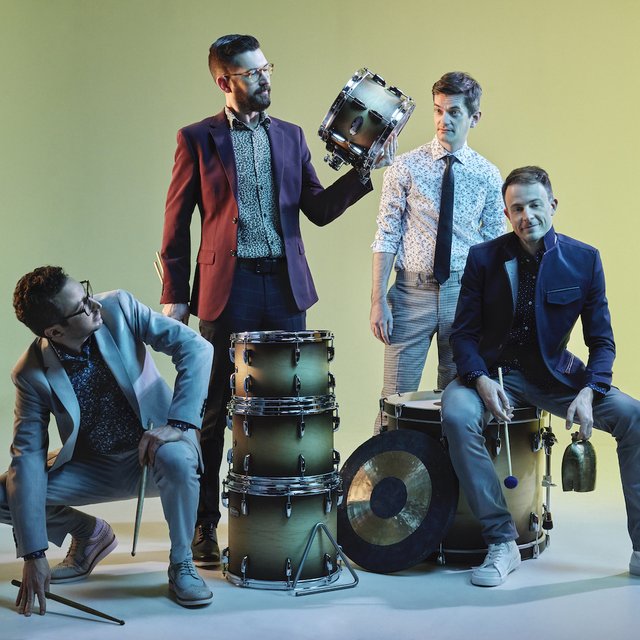
Drum Circles (2019) is a concerto in five movements for percussion ensemble and orchestra. Unlike a traditional concerto, which highlights one soloist’s individual artistry and abilities, Drum Circles involves close collaboration, particularly between the four percussion soloists and three orchestral percussionists. In a video trailer for the piece, Theofanidis likened Drum Circles to chamber music, saying, “Here, you get something which feels like an organism—like it’s part of something greater.”
The orchestral percussionists kick off the first movement, “Rivers and Anthems,” with two strokes of the bass drum, before the soloists enter on vibraphone, chimes, and crotales. Undulating strings and overlapping cascading figures in the orchestra paint the image of a turbulent river, ebbing and flowing in intensity throughout. “Sparks and Chants” begins mysteriously with a series of unpitched percussion instruments chirping in the darkness. A haunting modal chant melody is then passed between the marimba and orchestra, which builds to a triumphant full-orchestra outburst before fading to a single note.
You’d be hard-pressed not to crack a smile during the quirky third movement (“How Can You Smile When You’re Deep in Thought?”), with its delightful use of amplified typewriter and toy bells. The fourth movement, “Spirits and Drums,” sees the orchestral percussionists in a dramatic dialogue with the soloists, as if enacting an ancient ritual that awakens a dark force in the basses and cellos. After the mounting tension of the previous movement, “Three Chords and the Truth (Or, Learning to Breathe Again)” brings some relief with serene chords in the marimbas, which evolve into a radiant hymn.
—Katherine Buzard
Jean Sibelius (1865-1957)
Symphony No. 2 in D major, op. 43 (1901)
Scored for: two flutes, two oboes, two clarinets, two bassoons, four French horns, three trumpets, three trombones, tuba, timpani, and strings
Performance time: 43 minutes
First Grant Park Orchestra performance: Jul 29, 1936; Robert Sanders, conductor
In late 1900, Jean Sibelius was not in a good place. Grieving the loss of his youngest daughter, Kirsti, to typhus and worried about the Russian Empire’s incursions on Finnish autonomy, the composer was acting erratically—smoking, drinking, womanizing, and spending to excess. “You have sat at home long enough, Mr. Sibelius,” wrote Baron Axel Carpelan, an eccentric music-lover who had given Sibelius the idea to write an overture called Finlandia for the 1900 World’s Fair in Paris. Carpelan demanded that Sibelius go to Italy to recuperate and stimulate his creativity. “Everything there is lovely—even the ugly,” Carpelan assured him (even though he had never set foot in the country). Carpelan was penniless, but he had wealthy connections whom he convinced to pay for Sibelius and his family to rent a mountain villa in the Italian Riviera town of Rapallo for several months in early 1901. The change of scenery helped, spurring Sibelius to sketch what would become his Second Symphony.
The premiere of Sibelius’s Symphony No. 2 on March 8, 1902, marked a watershed moment in Finnish culture. Although Sibelius denied any programmatic intent, it was inevitable that the symphony would be read against the backdrop of Finland’s struggle for independence from Russia. Before declaring independence in 1917, Finland had special status as an autonomous Grand Duchy within the Russian Empire. However, Tsar Nikolas II’s “russification” program of 1899–1905 sought to strip Finland of its political autonomy and limit freedom of speech, assembly, and press. Sibelius composed several overtly political songs and pieces during this time, but said Symphony No. 2 was merely a “confession of the soul” with no broader meaning. Nevertheless, the work became an emblem of Finnish liberation.
Compositional background and programmatic intent aside, Symphony No. 2 is a remarkably original work in its construction. The “Allegretto” presents a series of diverse musical fragments. Pulsing string chords suggest a pastoral scene, answered by folksy winds and somber horns. After a brief silence, we enter new territory with a chilly melodic fragment in the flutes and bassoons. It is unclear where the music is going. As Sibelius put it, “It is as though the Almighty had thrown the pieces of a mosaic down from the floor of heaven and told me to put them together.” In the development section, instead of fragmenting themes from the exposition, as would be expected in a typical sonata-form symphonic movement, Sibelius binds them together, as if he had set a complicated logic puzzle for himself to work out.
Timpani rolls and a meandering pizzicato bass line set the tone of the dark “Andante.” The movement centers around two contrasting themes—a brooding bassoon melody in D minor inspired by the fate of legendary literary lothario Don Juan, and an ethereal, redemptive theme in F# major. Agitated strings begin a slow build-up to the anguished conclusion. The third movement, marked “Vivacissimo,” features more agitated strings in the blistering scherzo section, contrasted with a plaintive oboe melody in the trio section. The second time the trio comes around, Sibelius leads directly into the finale with a three-note ascending figure. Not only does this ascending figure become the majestic principal theme of the finale, but it also recalls the opening chords of the symphony, demonstrating the subtle motivic connection that underpins the whole work and adding to the finale’s sense of inevitability.
—Katherine Buzard
Event Sponsors
This concert is generously supported by Lori Julian for the Julian Family Foundation.
Artistic Leadership
Support The Festival
Grant Park Orchestra
* denotes leave-of-absence † one-year position
Jeremy Black, concertmaster
Dima Dimitrova, acting assistant concertmaster
Trista Wong
Zulfiya Bashirova
Jennifer Cappelli
Injoo Choi
Erica Hudson
Hyewon Kim
Matthew Lehmann
Jayna Park
Rika Seko
Karen Sinclair
Bonnie Terry*
Krzysztof Zimowski
Liba Shacht, principal
Likai He, acting assistant principal
Ying Chai
Karl Davies
Ann Lehmann
Laura Miller
Cristina Muresan
Kjersti Nostbakken
Irene Radetzky
Jeanine Wynton
Thomas Yang
Bing Jing Yu†
Terri Van Valkinburgh, principal
Yoshihiko Nakano, assistant principal
Elizabeth Breslin
Beatrice Chen
Georgi Dimitrov
Amy Hess
Rebecca Swan
Chloé Thominet
Walter Haman, principal
Peter Szczepanek, assistant principal
Calum Cook
Larry Glazier
Steven Houser
Eric Kutz*
Eran Meir
Shinae Ra
Colin Corner, principal
Peter Hatch, assistant principal
Andrew Anderson
Christian Luevano
Samuel Rocklin
Chunyang Wang
Chris White
Elvin Schlanger, principal
Alyce Johnson
Jennifer Lawson, assistant principal
Jennifer Lawson
Mitchell Kuhn, principal
Gwendolyn Goble
Anne Bach, assistant principal
Anne Bach
Dario Brignoli, principal
Trevor O’Riordan, assistant principal
Besnik Abrashi
Besnik Abrashi
Eric Hall, principal
Nicole Haywood Vera Tenorio, assistant principal
Matthew Melillo
Matthew Melillo
Patrick Walle, acting principal†
Stephanie Blaha, assistant principal
Neil Kimel
Brett Hodge
Paul Clifton
David Gordon, principal
Mike Brozick
Rebecca Oliverio, assistant principal
Jeremy Moeller, acting principal
Lee Rogers, acting assistant principal†
Alexander Mullins
Andrew Smith, principal
Daniel Karas, principal
Josh Jones, principal
Sean Edwards, acting assistant principal†
Doug Waddell
Lynn Williams, acting principal†
Christopher Guzman
Eliza Bangert, principal
Carlos Chacón, violin
Valentina Guillen Menesello, violin
Steven Baloue, viola
Miquel Fuentes, cello