

Tchaikovsky Symphony No. 5
Program
Joseph Schwantner Violin Concerto (33 mins)
pensieroso e oscura
Movendo
Intermission (20 mins)
Piotr Ilyich Tchaikovsky Symphony No. 5 in E Minor, op. 64, TH 29 (55 mins)
Andante - Allegro con anima
Andante cantabile con alcuna licenza
Valse: Allegro moderato
Finale: Andante maestoso - Allegro vivace
Featuring
Program Notes
Joseph Schwantner (b. 1943)
Violin Concerto (2021)
Scored for: two flutes including piccolo, two oboes including English Horn, two clarinets, two bassoons, two French horns, two trumpets, trombone, timpani, percussion, harp, solo violin, and strings
Performance time: 30 minutes
First Grant Park Orchestra performance.
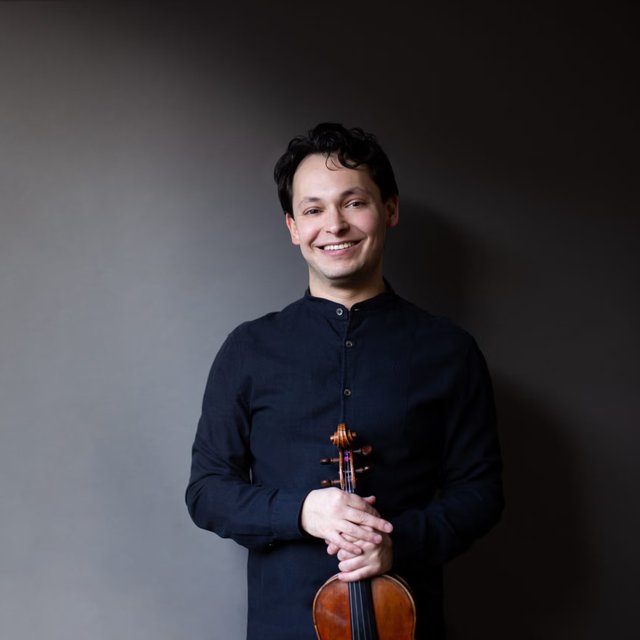
Composer Joseph Schwantner is a Chicago native with degrees from Chicago Conservatory College and Northwestern University. He has written several concertos across his illustrious career, including a Percussion Concerto for the 150th anniversary of the New York Philharmonic, a Piano Concerto for Emanuel Ax, and a Guitar Concerto for Sharon Isbin. His latest is a Violin Concerto, composed in 2021. The work grew out of a shorter soliloquy for violin and strings, The Poet’s Hour, commissioned in 2010 by the Seattle Symphony to honor the retirement of music director Gerard Schwarz. From the beginning, Schwantner knew he wanted to turn it into a larger work for violin and orchestra. When he heard violinist Yevgeny Kutik play The Poet’s Hour with Schwartz’s All-Star Orchestra, he knew he had found the soloist to bring his Violin Concerto to life. “Yevgeny Kutik brings a dramatic and an emotional arc to his impressive technique and captivating musical personality,” Schwantner writes in his program note, “and that vision remained in my mind’s ear all during the writing of the concerto.”
Leonard Slatkin conducted the premiere of Schwantner’s Violin Concerto with Kutik and the Detroit Symphony Orchestra in October 2021. This was by no means the first time Slatkin had premiered Schwantner’s work. Their collaboration dates back four decades, when Schwantner served as the first composer-in-residence with the Saint Louis Symphony Orchestra, of which Slatkin was music director. In his blog, Slatkin calls Schwantner’s Violin Concerto “one of the most impressive new pieces I have led in a long time. It holds the performers and audience in a kind of hypnotic trance and as is usual with Joe’s music, has an incredible range of colorful sounds . . . You will be astounded.”
The first movement begins ominously with tolling chimes, strokes of the bass drum, and a “slow unfolding harmony and a deep repeated orchestral pedal that introduces a darkly expressive melodic line played by cellos in their low register,” Schwantner writes. He continues, “The brooding character of these musical elements form the basis of the materials developed in this movement.” After the funereal introduction, the violin soloist enters with an anguished outpouring before the darkness briefly subsides, revealing a glassy melody doubled by piccolo over tremolo strings. Even amid the overarching angst of the movement, Schwantner maintains a sense of lightness through transparent orchestral textures and colorful combinations of instruments.
Angst is channeled into nervous energy in the second movement. The violin introduces a compact four-note figure, which is repeated obsessively before ascending in an arpeggio. Later, this gesture is heard as a ringing sonority in the piano and pitched percussion. Schwantner explains, “This notion of transformation of a musical idea from one context into new and different environments was an endlessly fascinating process of discovery I continually explored throughout both movements of the work.” The middle section features a plaintive duet between the violin soloist and principal cello. They play an extended passage in unison before the violin breaks off again, offering more ascending arpeggios over shimmering strings. The obsessive four-note figure of the opening returns in full orchestra before crashing to a demonstrative finish.
—Katherine Buzard
Piotr Ilyich Tchaikovsky (1840-1893)
Symphony No.5 in E minor, op. 64, TH 29 (1888)
Scored for: three flutes including piccolo, two oboes, two clarinets, two bassoons, four French horns, two trumpets, three trombones, tuba, timpani, and strings
Performance time: 44 minutes
First Grant Park Orchestra performance: Aug 4, 1935; Eric DeLamarter, conductor
In May 1888, Piotr Ilyich Tchaikovsky took up residence in a country home in Frolovskoye, a small village between Moscow and Klin. There, he delighted in taking long walks in the surrounding woodland and pottering in the garden. “Just now I am busy with flowers and flower-growing,” he wrote to his patroness, Nadezhda von Meck, in early June. “I should like to have as many flowers as possible in my garden, but I have very little knowledge or experience.” Although he had intended to write a symphony while in Frolovskoye, he had a bad case of writer’s block, which was making him anxious. “To speak frankly, I feel as yet no impulse for creative work,” he wrote to his brother Modest. “What does this mean? Have I written myself out? No ideas, no inclination.” Just as his flowers eventually flourished, so too did his inspiration. By mid-June, he had begun work on his Fifth Symphony and finished orchestrating it by mid-August.
A note dated April 15, 1888, outlines a potential program for the first movement of a symphony. In this program, he envisions the introduction as a “total submission before fate,” while the ensuing Allegro contains “murmurs, doubts, laments, reproaches against...XXX.” For the second movement, he writes, “Shall I cast myself into the embrace of faith??? A wonderful programme, if only it can be fulfilled.” These mysterious scribblings have led many to interpret Symphony No. 5 as depicting triumph over some sort of adversity (i.e., whatever “XXX” signifies), with the symphony’s recurring musical motto acting as a “fate motif.” However, Tchaikovsky quickly abandoned the proposed program, and the resulting music bears little resemblance to these early sketches. Plus, he made a point of writing to Grand Duke Konstantin Romanov in June to say he was “composing a symphony without a program.”
Even so, it is hard not to hear Tchaikovsky’s Fifth Symphony as having some underlying narrative as the “fate motif” is transformed throughout the work. In the introduction of the first movement, low clarinets introduce the motto as a quietly insistent funeral march with a distinctive rhythmic profile. After a pause, the movement begins in earnest with a melancholy principal theme that recalls the fate motif in harmony, melodic contour, and scoring for low winds. As the orchestration builds and the tempo mounts, the movement gradually moves away from its resigned opening to reach a joyful climax.
In the Andante, the solo horn sings one of Tchaikovsky’s most poignant melodies. (You may recognize it from the 1939 song “Moon Love,” made popular by Frank Sinatra.) The oboe and clarinet offer countermelodies that push the tempo forward before the fate motif rudely bursts in like an unwanted guest in the form of a brass fanfare. This interjection brings the music to a crashing halt, but the melody quietly returns over pizzicato strings. However, the fate theme has not left the party. It angrily reasserts itself when it seems like the movement is drawing to a peaceful close.
The motto is absent from the third movement’s graceful waltz, only appearing as a faint specter at the end. In the Finale, the motto is transformed into a resolute hymn in E major, which takes on a militant energy in the suspenseful buildup. After a fake-out ending that has caught many an unsuspecting concertgoer off guard, the motto bursts forth in its final triumphant form. Even the principal melody of the first movement is brought back as the symphony hurtles to the finish line, this time in a blazing brass fanfare in E major.
—Katherine Buzard
Artistic Leadership
Event Sponsors
This concert is generously sponsored by Performance Wealth.

Support The Festival
Grant Park Orchestra
* denotes leave-of-absence † one-year position
Jeremy Black, concertmaster
Dima Dimitrova, acting assistant concertmaster
Trista Wong
Zulfiya Bashirova
Jennifer Cappelli
Injoo Choi
Erica Hudson
Hyewon Kim
Matthew Lehmann
Jayna Park
Rika Seko
Karen Sinclair
Bonnie Terry*
Krzysztof Zimowski
Liba Shacht, principal
Likai He, acting assistant principal
Ying Chai
Karl Davies
Ann Lehmann
Laura Miller
Cristina Muresan
Kjersti Nostbakken
Irene Radetzky
Jeanine Wynton
Thomas Yang
Bing Jing Yu†
Terri Van Valkinburgh, principal
Yoshihiko Nakano, assistant principal
Elizabeth Breslin
Beatrice Chen
Georgi Dimitrov
Amy Hess
Rebecca Swan
Chloé Thominet
Walter Haman, principal
Peter Szczepanek, assistant principal
Calum Cook
Larry Glazier
Steven Houser
Eric Kutz*
Eran Meir
Shinae Ra
Colin Corner, principal
Peter Hatch, assistant principal
Andrew Anderson
Christian Luevano
Samuel Rocklin
Chunyang Wang
Chris White
Elvin Schlanger, principal
Alyce Johnson
Jennifer Lawson, assistant principal
Jennifer Lawson
Mitchell Kuhn, principal
Gwendolyn Goble
Anne Bach, assistant principal
Anne Bach
Dario Brignoli, principal
Trevor O’Riordan, assistant principal
Besnik Abrashi
Besnik Abrashi
Eric Hall, principal
Nicole Haywood Vera Tenorio, assistant principal
Matthew Melillo
Matthew Melillo
Patrick Walle, acting principal†
Stephanie Blaha, assistant principal
Neil Kimel
Brett Hodge
Paul Clifton
David Gordon, principal
Mike Brozick
Rebecca Oliverio, assistant principal
Jeremy Moeller, acting principal
Lee Rogers, acting assistant principal†
Alexander Mullins
Andrew Smith, principal
Daniel Karas, principal
Josh Jones, principal
Sean Edwards, acting assistant principal†
Doug Waddell
Lynn Williams, acting principal†
Christopher Guzman
Eliza Bangert, principal
Carlos Chacón, violin
Valentina Guillen Menesello, violin
Steven Baloue, viola
Miquel Fuentes, cello