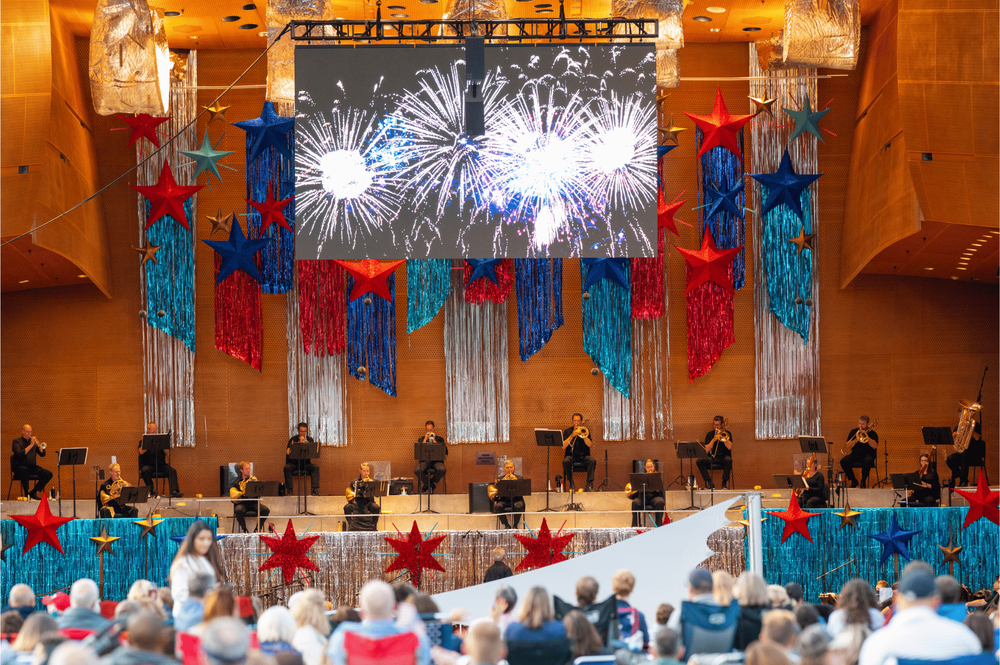
Celebrate America250
July 4, 2026, marks America’s semiquincentennial, or 250th birthday. On July 4, 1776, delegates at the Second Continental Congress voted to approve the Declaration of Independence, dissolving the political bands between the Thirteen Colonies and the Kingdom of Great Britain and asserting their status as “free and independent states.” Thus, the American experiment began. Two hundred fifty years later, we’re still debating what it means to be American. This season, the Grant Park Music Festival is exploring this very question through what we know best—great music.
“As a summer music festival founded in a great American city, built on the belief that great music should be free and accessible to everyone—and with a long history of celebrating American music and the ever‑evolving American sound—embracing America250 as the inspiration for this season just made sense for us,” Festival CEO Paul Winberg said.

In planning the 2026 season, Artistic Director Giancarlo Guerrero wanted to build upon the Festival’s longstanding commitment to music by American composers by challenging preconceived notions of what “American music” is. He broadens the definition to include composers who “found refuge in the United States, who wrote significant repertoire in this country, and were influenced by its foundational ideals” to demonstrate the richness of the American musical landscape and America’s influence on the arts globally.
This means including composers such as Sergei Rachmaninov and Igor Stravinsky (July 1, 3), who came to the United States to escape political turmoil in Europe in the early 20th century and even became US citizens in the 1940s. Composers who found musical inspiration in America are also included, like Maurice Ravel (July 15), who gained an appreciation for jazz while club hopping in Harlem with George Gershwin, and Antonín Dvořák, whose “New World” Symphony (August 12) provided a template for young American composers seeking a distinct national style.
That said, each program will include the music of at least one American-born or American-based composer. The first concert of the season (June 10) is entirely homegrown, with Joan Tower’s Made in America featuring alongside Leonard Bernstein’s Symphonic Dances from West Side Story and Samuel Barber’s Symphony No. 1, a classic example of a mid-twentieth-century American symphony.
Alongside the towering figures of American music like Bernstein, Barber, and Copland, this season features music by dozens of contemporary American composers, from pioneers of minimalism Philip Glass and John Adams (August 12) to Julia Wolfe, whose orchestral overture Liberty Bell (August 15/16) was co-commissioned by the Grant Park Music Festival to celebrate America250. The Festival has also commissioned new works from composers Clarice Assad and Jasmine Barnes for the string and vocal fellows. In addition, this season will feature several Chicago premieres of exciting contemporary works, including Jimmy Lopez’s Loud (July 26/27), Christopher Theofanidis’s Drum Circles with Third Coast Percussion (July 8), and Joseph Schwantner’s Violin Concerto (July 10/11).
Our musical celebration of America250 extends beyond merely highlighting American composers and music. The season has been thoughtfully curated to reflect the complexity of what it means to be American—the achievements and ideals on which this country was founded, as well as the darker aspects of our past and present that stand in the way of fulfilling these ideals.
For instance, in Cirque: A Space Odyssey (July 22), we celebrate American innovation in the field of space exploration with a program of classical and cinematic space-inspired music. We honor the contributions of LGBTQ+ musicians and composers in our Pride Concert (June 26/27), while memorializing those lost to AIDS with John Corigliano’s Symphony No. 1 (August 7/8). We also acknowledge the pain and destruction wrought by and left in the wake of colonialism in the Americas through Gabriela Lena Frank’s Conquest Requiem (June 12/13) and James MacMillan’s Cantos Sagrados (July 17/18).
Black history forms an integral part of our commemoration of America250. On June 17, we hear Julia Perry’s Short Piece, a concise masterwork by a composer whose race and sex were obstacles to her having the career she deserved. We also present the Festival premiere of Symphony No. 3 by Chicagoan Florence Price, alongside Festive Overture by the “Dean of African American Composers” William Grant Still (July 15). Then, conductor Kedrick Armstrong makes his Grant Park debut with An Evening with Ben Folds (July 29), followed by a program featuring Coleridge Taylor Perkinson’s Sinfonietta No. 1, Samuel Coleridge-Taylor’s Violin Concerto, and Duke Ellington’s The Three Black Kings, a piece intended as a eulogy for Dr. Martin Luther King, Jr. (July 31/August 1).
Any celebration of what it means to be American would be incomplete without acknowledging the contributions of immigrants. As President John F. Kennedy wrote in his book A Nation of Immigrants, “Everywhere immigrants have enriched and strengthened the fabric of American life.” Those words are just as true today as they were when he wrote them nearly 70 years ago.
On June 24, we present Peter Boyer’s Ellis Island: The Dream of America, a poignant multimedia work that brings together symphonic music, dramatic recitations, and visual projections to tell the story of the American immigrant experience in the early 20th century. Our August 5 concert then celebrates three prominent immigrant populations in our city—Mexican, Polish, and Italian—with Juan Pablo Contreras’s Mariachitlán, Chopin’s Piano Concerto No. 2, and Tchaikovsky’s Capriccio Italien. We also feature several soloists who have made the United States their home, including Belarusian–American violinist Yevgeny Kutik in Joseph Schwantner’s Violin Concerto (July 10/11) and Russian–American pianist Olga Kern in Rachmaninov’s Piano Concerto No. 3 (July 1/3).
Capping off the season is none other than Beethoven’s Ninth Symphony (August 14/15). Written in a time of political upheaval and repression following the Napoleonic Wars, Beethoven’s epic final symphony makes a bold philosophical statement. “All men become brothers,” the chorus proclaims in the famous “Ode to Joy.” What better way to conclude our musical celebration of 250 years of the American experiment than to remind us of the ideals on which our country was founded: freedom, democracy, and above all, our common humanity.