
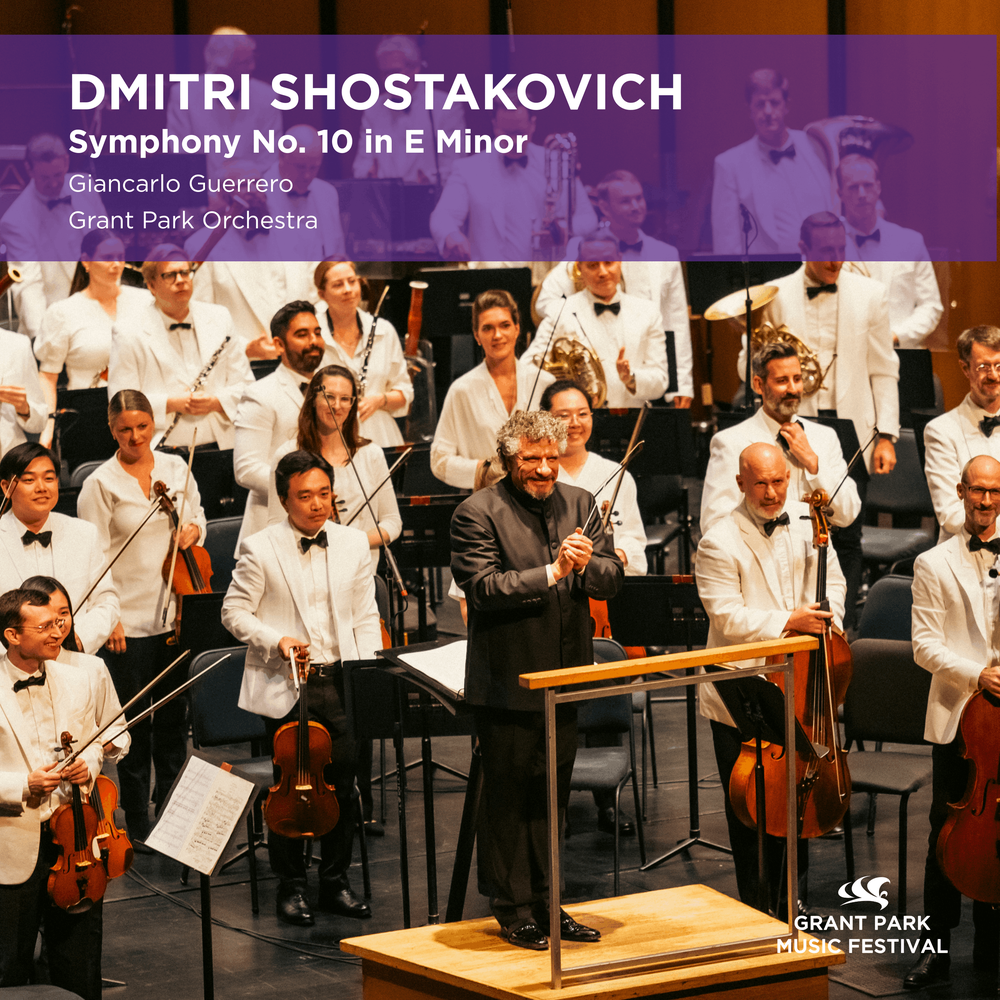
New Release from the Grant Park Orchestra
Out Now: Shostakovich Symphony No. 10
In Summer 2025, Festival Artistic Director and Principal Conductor Giancarlo Guerrero led the Grant Park Orchestra in a riveting performance of Shostakovich Symphony No. 10. The piece was recorded indoors at the Harris Theater on Saturday, June 27.
Self-released under the Grant Park Music Festival, this will be the Grant Park Orchestra's first release in 15 years.
The recording will be available on Spotify, Apple Music, and all streaming platforms on Friday, May 8.
Program Notes
Dmitri Shostakovich (1906–1975)
Symphony No. 10 in E minor, op. 93 (1953)
Scored for: three flutes including piccolo, three oboes including English Horn, three clarinets including bass clarinet, three bassoons including contrabassoon, four French horns, three trumpets, three trombones, tuba, timpani, percussion, and strings
Performance time: 57 minutes
First Grant Park Orchestra performance: July 9, 1986; Christopher Lyndon-Gee, conductor
Dmitri Shostakovich wrote his Tenth Symphony after a conspicuous eight-year hiatus from the very genre that had made him famous. Shostakovich’s Ninth Symphony, written in 1945, was poorly received and was eventually banned in 1948 when the Central Committee of the Communist Party, led by Stalin watchdog Andrei Zhdanov, published a doctrine banning musical works that did not comply with the nebulous principles of “socialist realism.” The decree accused Shostakovich and many of his colleagues of “formalism” and “cosmopolitanism” (an anti-Semitic euphemism), branding him an enemy of the people.
Stalin’s death in March 1953 led to a gradual thawing of ideologically driven aesthetic constraints and a return to greater artistic freedom. Shostakovich began work on Symphony No. 10 that summer and completed it in the fall. Despite the enthusiastic reception at its premiere in Leningrad on December 17, Shostakovich’s reentry into the symphonic arena still prompted debate among his fellow composers. His symphony was the subject of three days of discussion at the Composer’s Union the following spring. The work’s lack of a program raised critics’ suspicions about its underlying meaning. Additionally, opponents found it overly seriously, insufficiently melodic, and too complex to appeal to a wide audience. Supporters, on the other hand, lauded the symphony for its mastery and innovation. For instance, composer Aram Khachaturian, who had also been implicated in Zhdanov’s 1948 decree, called it “an optimistic tragedy, infused with a firm belief in the victory of bright, life-affirming forces.”
Shostakovich publicly said there was no program associated with the Tenth Symphony, stating he only “wanted to portray human emotions and passions.” However, his potentially specious memoirs, Testimony, collected by musicologist Solomon Volkov and published posthumously in 1979, tell a slightly different story. “Shostakovich summed up Stalin’s era in the Tenth Symphony,” Volkov writes. “The second movement is inexorable, merciless, like an evil whirlwind—a ‘musical portrait’ of Stalin.” Of course, anything in Testimony must be taken with a grain of salt, as Volkov likes to paint all of Shostakovich’s works as veiled criticisms of Stalin.
The brooding first movement begins with low, quiet strings that meander in harmonic ambiguity before a lonely clarinet melody offers clarity in E minor. This clarinet theme demonstrates Mahler’s profound influence on Shostakovich, as it quotes the fourth movement of Mahler’s Second Symphony, where the mezzo-soprano soloist sings, “Der Mensch liegt in grösster Noth! Der Mensch liegt in größter Pein!” (“Man lies in direst need! Man lies in greatest pain!”). A second theme comes in the form of a nervous flute solo over plucked strings. The bassoons and contrabassoons introduce the development section, which builds into an intense triple forte. The movement ends with a single piccolo over ominous timpani rolls.
The second movement is a vicious scherzo. At just under five minutes, it proceeds with a relentless ferocity that could only be sustained over such a short movement. In contrast, the subsequent allegretto shares a scherzo-like quality but adopts a very different tone—one that is more wary than terrified. It also introduces Shostakovich’s musical monogram: “DSCH.” It comes from the German transliteration of his name (“D. Schostakowitsch”) and the German system of spelling musical notes, whereby E-flat is “S” and B-natural is “H,” forming the sequence D–E-flat–C–B. Pensive horn calls punctuate the various iterations and transformations of this musical fragment. After a melancholy Andante section, the finale’s lively Allegro brings the tragic optimism Khachaturian alluded to, ending with a final triumphant stamp of Shostakovich’s musical signature in the horns amid a flurry of string and wind activity.
—Katherine Buzard
Orchestra Roster
Jeremy Black
Trista Wong
Dima Dimitrova
Rika Seko
Matt Lehmann
Injoo Choi
Zulfiya Bashirova
Jennifer Cappelli
Erica Hudson
Krzysztof Zimowski
Laura Park Chen
Karen Sinclair
Bonnie Terry
Irene Radetzky
Liba Shacht
Likai He
Ran Cheng
Kjersti Nostbakken
Jeanine Wynton
Karl Davies
Ying Chai
Tom Yang
Ann Lehmann
Janis Sakai
Bing Jing Yu
Erik Lijenberg
Terri Van Valkinburgh
Yoshihiko Nakano
Christopher McKay
Beatrice Chen
Amy Hess
Rebecca Swan
Chloe Thominet
Edwardo Rios
Walter Haman
Eran Meir
Calum Cook
Eric Kutz
Larry Glazier
Heidi Hoffman
Walter Preucil
Colin Corner
Peter Hatch
Andrew Anderson
Chunyang Wang
Christian Luevano
Chris White
Jennifer Lawson
Jennifer Clippert
Alyce Johnson
Mitchell Kuhn
Alex Liedtke
Anne Bach
Dario Brignoli
Trevor O'Riordan
Insoo Oh
Eric Hall
Nicole Haywood Vera Tenorio
Juan de Gomar
Patrick Walle
Neil Kimel
Brett Hodge
Paul Clifton
Stephanie Blaha, Asst.
David Gordon
Austin Cruz
Michael Brozick
David Inmon
Jeremy Moeller
Lee Rogers
Alex Mullins
Andrew Smith
Daniel Karas
Josh Jones
Joel Cohen
Doug Waddell
Rich Janicki
Lynn Williams