

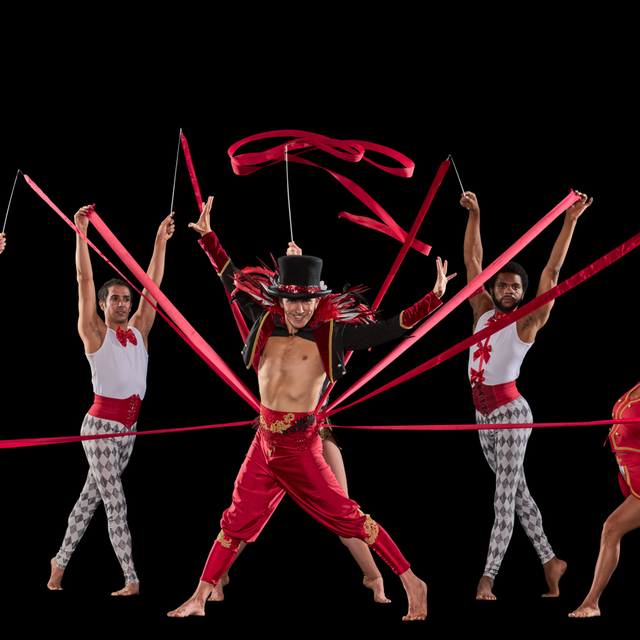
Cirque: A Space Odyssey
Program
Richard Strauss Introduction to Also Sprach Zarathustra (2 mins)
Peter Boyer Silver Fanfare from On Music's Wings (4 mins)
Claude Debussy/orch. André Caplet Clair de lune (5 mins)
Jeff Tyzik Galileo (6 mins)
Mary Howe Stars (4 mins)
Bart Howard Fly Me to the Moon (3 mins)
Jeff Tyzik Lift Off (5 mins)
Mary Howe Stars (4 mins)
John Williams Flying Theme from E.T.: the Extra-Terrestrial (4 mins)
Jerry Goldsmith End Title from Star Trek the Motion Picture (4 mins)
John Williams The Imperial March from Star Wars (5 mins)
Michael Giacchino Jyn Erso & Hope Suites from Rogue One: A Star Wars Story (6 mins)
Robert Wendel Flintstones Meet the Jetsons (4 mins)
Michael Giacchino Into Darkness Suite from Star Trek (7 mins)
Featuring

Program Notes
When the Voyager space probes were launched in 1977, they each carried an identical golden phonograph record—an intergalactic time capsule that distills what it means to be human for any alien life-form that might intercept it. Alongside the analog-encoded images, nature sounds, and greetings in 55 languages, these discs include over two dozen musical tracks spanning eras and cultures, from Bach’s Well-Tempered Clavier to Chuck Berry’s “Johnny B. Goode.” Who knows what the aliens will make of it all. But to us, the message is clear: creative expression is just as fundamental to our humanity as our yen for exploration and fascination with the cosmos.
On this program of classical and cinematic space-inspired music, we begin with one of the most iconic pieces of music to be associated with space: the Introduction to Also sprach Zarathustra. When Stanley Kubrick chose Richard Strauss’s tone poem for 2001: A Space Odyssey (1968), the piece’s connection with outer space and evolution became ingrained in popular culture, referenced and parodied to no end. The opening brass arpeggio, outlining the first notes of the harmonic series, captures both the heroism of space exploration and our primal beginnings. Continuing in this spirit, Peter Boyer’s Silver Fanfare, while not composed with outer space in mind, follows from Strauss’s epic crescendo to take us on a journey at warp speed.
Kubrick was highly intentional in the classical music he chose for his films. Another famous example from 2001: A Space Odyssey is Johann Strauss Jr.’s On the Beautiful Blue Danube, used to accompany balletic scenes of the spaceship flying and docking. Using a Viennese waltz from 1866 marks a departure from the eerie electronic sounds of earlier sci-fi films. The waltz, by contrast, conveys a sense of weightlessness and comfort. “Space travel is no longer a white-knuckle adventure for the highly trained,” Christine Lee Gengaro notes in her book Listening to Stanley Kubrick: The Music in His Films. “Now it’s like flying to an international location.”
Around the same time that author H.G. Wells was capturing readers’ imaginations with tales of space travel and alien invasions in his groundbreaking science fiction novels, composer Claude Debussy was viewing the cosmos with a more poetic lens. Clair de Lune, or “Moonlight,” is the third movement of Debussy’s Suite bergamasque (1890, rev. 1905), a piano suite inspired by the poetry of Paul Verlaine. In Verlaine’s “Clair de lune,” masked revelers make music and dance in a charmed landscape, their songs mingling with the light of the moon.
The moon became a more tangible concept on July 21, 1969, when Neil Armstrong and Buzz Aldrin landed their lunar module at Tranquility Base. The soundtrack for that definitive moment: Fly Me to the Moon. Originally composed by Bart Howard in 1954, the song gained popularity in the 1960s as the space race dominated headlines. When the Eagle touched down on the lunar surface, the astronauts played Frank Sinatra and Count Basie’s 1964 recording on a portable cassette player, making it the first human-made music to be heard on the moon.
Like Clair de Lune, Mary Howe’s Stars also began as a piano piece. Composed in 1934, the miniature tone poem “was inspired by the gradually overwhelming effect of the dome of a starry night—its beauty, peace and space,” Howe wrote. Continuing on the theme of stars, Jeff Tyzik’s Lift Off and Galileo are drawn from the composer’s Star Suite, written for the 2024 solar eclipse. Liftoff depicts a manned space flight exiting Earth’s orbit on a mission to a distant planet, while Galileo honors the Italian polymath, whose telescopic discoveries revolutionized our understanding of the solar system.
The second half of the program celebrates music from cinematic depictions of space and flight. First, we have two titans of blockbuster film scoring: Jerry Goldsmith and John Williams. Jerry Goldsmith’s score for Star Trek: The Motion Picture (1979) kicked off his long association with the franchise, leading to four more Star Trek films and three television series. One of Goldsmith’s inspirations was his contemporary John Williams, whose score for Star Wars: A New Hope (1977) helped revitalize “golden-age” film music. Like Kubrick, Williams changed our perception of what sci-fi “should” sound like, moving away from avant-garde, synth-tinged scores of the 1950s and ’60s to a sweeping, romantic orchestral sound. With his music, the vacuum of space becomes an arena for swashbuckling adventures and human stories instead of a cold and isolated void.
As a composer for several large film franchises, Michael Giacchino might be considered a successor to the likes of John Williams and Jerry Goldsmith. When he was tasked with scoring Rogue One: A Star Wars Story in 2016, he paid homage to his predecessor by echoing themes from Williams’s original Star Wars soundtracks. While Giacchino has provided music for numerous sci-fi and fantasy film franchises, including Star Trek Into Darkness, he has also scored a string of popular Pixar films. His charming soundtrack for Up won him his first Academy Award in 2010.
Before Pixar came to dominate animation, there was Hanna-Barbera Cartoons, an animation studio that produced beloved television cartoons such as Scooby-Doo, The Smurfs, and Yogi Bear. Hoyt Curtin was the production company’s primary music director, composing the iconic themes for Hanna-Barbera’s sitcoms The Flintstones (1960) and The Jetsons (1962). In a 1987 crossover episode, these two beloved cartoon families meet face to face when a time travel experiment goes awry. Robert Wendel’s arrangement, The Flintstones Meet the Jetsons, nods to this special in its medley of themes from the beloved Stone Age and Space Age families.
—Katherine Buzard
Event Sponsors
This concert is generously sponsored by the Mazza Foundation and Latham & Watkins, LLP.
Artistic Leadership

Support The Festival

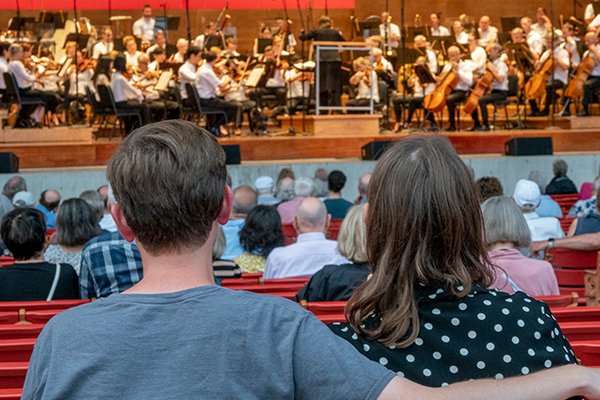
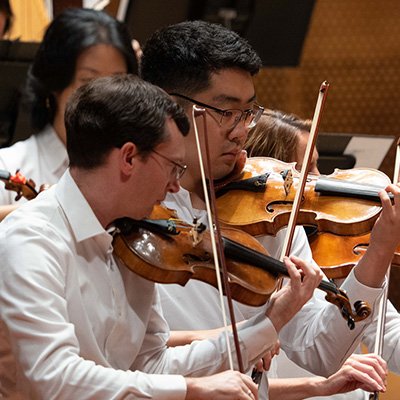
Grant Park Orchestra
* denotes leave-of-absence † one-year position
Jeremy Black, concertmaster
Dima Dimitrova, acting assistant concertmaster
Trista Wong
Zulfiya Bashirova
Jennifer Cappelli
Injoo Choi
Erica Hudson
Hyewon Kim
Matthew Lehmann
Jayna Park
Rika Seko
Karen Sinclair
Bonnie Terry*
Krzysztof Zimowski
Liba Shacht, principal
Likai He, acting assistant principal
Ying Chai
Karl Davies
Ann Lehmann
Laura Miller
Cristina Muresan
Kjersti Nostbakken
Irene Radetzky
Jeanine Wynton
Thomas Yang
Bing Jing Yu†
Terri Van Valkinburgh, principal
Yoshihiko Nakano, assistant principal
Elizabeth Breslin
Beatrice Chen
Georgi Dimitrov
Amy Hess
Rebecca Swan
Chloé Thominet
Walter Haman, principal
Peter Szczepanek, assistant principal
Calum Cook
Larry Glazier
Steven Houser
Eric Kutz*
Eran Meir
Shinae Ra
Colin Corner, principal
Peter Hatch, assistant principal
Andrew Anderson
Christian Luevano
Samuel Rocklin
Chunyang Wang
Chris White
Elvin Schlanger, principal
Alyce Johnson
Jennifer Lawson, assistant principal
Jennifer Lawson
Mitchell Kuhn, principal
Gwendolyn Goble
Anne Bach, assistant principal
Anne Bach
Dario Brignoli, principal
Trevor O’Riordan, assistant principal
Besnik Abrashi
Besnik Abrashi
Eric Hall, principal
Nicole Haywood Vera Tenorio, assistant principal
Matthew Melillo
Matthew Melillo
Patrick Walle, acting principal†
Stephanie Blaha, assistant principal
Neil Kimel
Brett Hodge
Paul Clifton
David Gordon, principal
Mike Brozick
Rebecca Oliverio, assistant principal
Jeremy Moeller, acting principal
Lee Rogers, acting assistant principal†
Alexander Mullins
Andrew Smith, principal
Daniel Karas, principal
Josh Jones, principal
Sean Edwards, acting assistant principal†
Doug Waddell
Lynn Williams, acting principal†
Christopher Guzman
Eliza Bangert, principal
Carlos Chacón, violin
Valentina Guillen Menesello, violin
Steven Baloue, viola
Miquel Fuentes, cello